
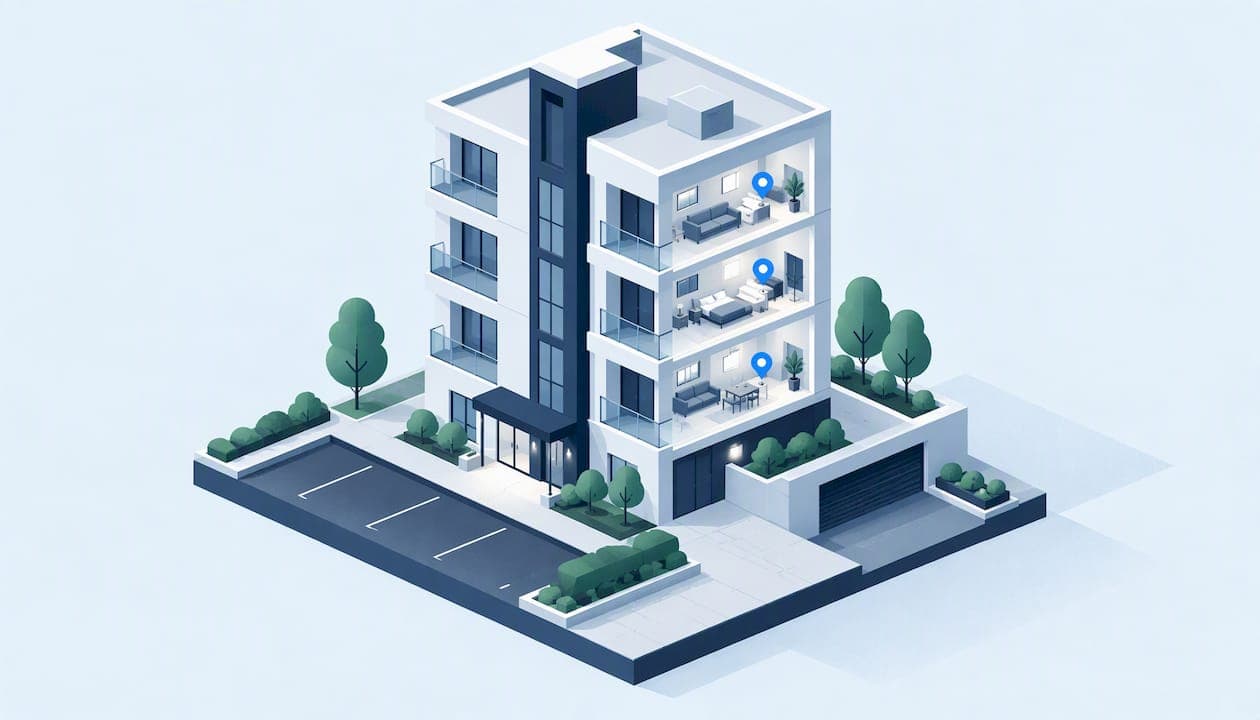
Yes, condos can have elevated radon, and living above the ground floor does not make a unit safe. The only way to know is to test the unit. If the result is at or above 4.0 pCi/L, the next steps usually involve your condo association, because the foundation and the soil beneath it are typically shared property.
This guide covers how radon gets into multi-unit buildings, how to test a condo properly, what to do with the number, and why mitigation takes more coordination than it does in a single-family house. We do radon testing and mitigation in the Greater Cincinnati area, so we also point out what matters locally.
TL;DR
- Radon is an invisible, odorless gas that can show up in any building, including condos, regardless of age, foundation or floor.
- The EPA's action level is 4.0 pCi/L, and it suggests considering repairs between 2.0 and 4.0 pCi/L.
- Test the unit you live in, not just the lowest floor of the building, and test again if the first number is high.
- In most condo buildings, the slab and sub-slab area are common elements, so fixing a problem usually needs board approval.
- If you are buying or selling, ask early what testing has already been done in the building.
Table of Contents
- Is radon common in condos?
- Why upper floors are not automatically safe
- How to test radon in a condo
- What your result means
- Who is responsible for radon in a condo?
- How radon is fixed in a condo
- Our perspective: treat the building, not just the unit
- Buying or selling a condo
- Work with us in Greater Cincinnati
- FAQ
- Sources
Is radon common in condos?
Radon is a radioactive gas that forms in soil and rock and moves into buildings from the ground. The EPA notes it is found in buildings of all kinds, and that any home can have a problem regardless of construction quality. A condo is a home in that sense.
A CDC-hosted study of indoor radon tests from 2005 to 2017, covering 46 states and D.C., found that about 35.4% of tests were at or above 4.0 pCi/L. That dataset is not limited to condos, and it comes from people who chose to test, so do not read it as the odds for your building. It does show that high readings are far from rare.
Our part of Ohio is also a place where radon deserves attention. The geology under the Greater Cincinnati area makes radon a regional concern, which is why we treat a clean result in a neighboring building as no guarantee for yours. Radon levels can differ a lot between two buildings on the same street, and even between two units in the same building.

Why upper floors are not automatically safe
The common assumption is a simple ladder: basement worst, ground floor next, third floor fine. The EPA does say radon levels are often highest in the lowest part of a building, which is why testing the basement or ground floor is a sensible starting point in a house.
Buildings with several stories behave differently. Warm indoor air rises and leaves the building at the top, which pulls replacement air in at the bottom. That is the stack effect. In a tall building it can draw soil gas through utility penetrations, elevator pits, stairwells and gaps in the structure, and carry it upward. The research behind our guidance on this point is covered in the CDC-hosted temporal variation study, which also notes elevated levels can occur throughout a structure, multi-unit residential buildings included.
What this means in practice:
- A third-floor unit might test fine while a first-floor unit tests high. Or not. You cannot tell by looking.
- Units with direct contact to the slab, such as ground-floor condos or units over a garage or crawl space, are the first to check.
- Tight, well-sealed units are not safer. Sealing makes a building hold indoor air longer, and EPA guidance is that sealing alone has not been shown to lower radon levels significantly or consistently.
How to test radon in a condo
Testing a condo is simple for the owner. It becomes complicated for the building, because shared structures need their own approach. The multifamily standard from AARST, ANSI/AARST MAMF, sets procedures and minimum requirements for measuring radon in buildings with more than one attached dwelling or occupied unit.
Testing your own unit
- Pick the right room. Test in the lowest lived-in level of your unit, usually a bedroom or living room, not a bathroom or kitchen where fans and humidity interfere.
- Keep closed-building conditions. Windows and exterior doors stay shut except for normal entry and exit, and you avoid running whole-unit fans or window air conditioners that pull outside air through the space.
- Choose the test length. A short-term test runs a few days and is the usual choice during a sale. A longer test gives a better picture of your average exposure.
- Get it analyzed by a lab or use a professional continuous monitor. Professional testing also gives you documentation that a buyer, lender or board will accept.
- Read the result in pCi/L. Compare it to the 4.0 level, then decide on a follow-up.
We go deeper on timing in our article on why 48 hours may not be enough, and on confirming a result near 4 pCi/L.
Testing across the building
If you sit on the board or manage a building, a single reading is not enough. Because radon can travel through shared pathways, a sound testing plan samples units on several levels, not only the lowest. Multifamily protocols exist because shared ownership and building management change how tests are placed, who is notified and who acts on results.

When to test
Radon concentrations swing by season. In the CDC-hosted dataset, monthly means were highest in January (about 203.8 Bq/m3) and lowest in July (about 129.5 Bq/m3). Colder months give a more conservative estimate of your annual exposure, but testing is encouraged year-round. It is October now, and heating season is starting, which makes the next few months a good window.
What your result means
| Result (pCi/L) | What the EPA says | Typical next step |
|---|---|---|
| Below 2.0 | Below the range where the EPA suggests considering repairs | Retest periodically, and after major changes to the building |
| 2.0 to 3.9 | The EPA suggests considering repairs because no level is known to be safe | Run a longer test and talk to your board |
| 4.0 and above | At the action level, where the EPA recommends taking action | Confirm with a second test, then plan mitigation |
A single short-term reading is a snapshot. The EPA's own guidance for real estate is that short-term tests are standard for a sale, yet a high result should be followed by more testing or a professional assessment before anyone commits to a permanent fix. If you want help reading a number you already have, our post on radon test results at 4 pCi/L walks through the logic.
Radon causes lung cancer, and the risk grows with long exposure. If you smoke or have a family history of lung disease, speak with your doctor about what an elevated result means for you.
Who is responsible for radon in a condo?
This is where condos differ most from houses. The answer depends on your governing documents and, in some places, on local law.
- Common elements. The foundation, slab and the soil gas beneath it are generally common elements. The association typically handles anything touching them.
- Inside your unit. You are generally responsible for your own interior, but you cannot just drill a hole in a shared slab. Doing so could affect the structure or break your bylaws.
- Disclosure. One condo-law commentary notes that boards generally have no obligation to disclose radon levels to prospective buyers or lenders, though many boards voluntarily share results. Check your own resale documents, and ask directly.
Because rules differ by state, association and building, read your declaration and bylaws, and consult a real estate attorney in Ohio if responsibility is unclear. Ohio's radon rules do not make this simple, so do not assume the board will pay, and do not assume you will.
How radon is fixed in a condo
In a house, the standard fix is a sub-slab depressurization system: a pipe through the slab, a fan, and a vent above the roof. EPA guidance describes a vent pipe and fan system as the usual approach.
In a condo building the same principle applies, but the design has to fit the structure:
- Shared foundations. If the slab is continuous under several units, treating one unit may not reduce levels in the others, and a single-unit system may be ineffective if the source is the shared foundation.
- Pipe routing. The vent must exit safely, and the route through chases, closets or exterior walls needs board approval.
- Fan noise and location. Neighbors will notice a poorly placed fan, so placement matters in attached housing.
- Verification. After any system goes in, a follow-up test confirms it works. We include post-installation verification testing with every mitigation.
For design background, see our article on system design starting with foundation tests, and our page on radon mitigation systems. For larger buildings, our post on commercial radon mitigation and the one on radon in apartments cover the owner's side.
Our perspective: treat the building, not just the unit
We focus only on radon, and condo calls are some of the trickiest we get. The pattern we see is that owners worry about their own unit, while the answer lies in the shared structure under it.
Our approach starts with measurement. We do not recommend a system before we understand the foundation, how air moves through the building and who has to approve work. Every design is tailored to the site, and every written quote is fixed, with no added costs after quoting. Our installations are ANSI/AARST certified, and every mitigation ends with verification testing and documentation you can hand to a buyer, an agent or a lender.
For owners, our advice is simple. Test first. If the number is at or above 4.0 pCi/L, retest to confirm, then bring the result to your board in writing, with a clear ask: a building-level assessment. A board is far more likely to act on a documented number than on a worry.
— Yoshua
Buying or selling a condo
Radon often surfaces during a sale, when time is short. A few practical points:
- Buyers: Put a radon test in your inspection contingency, and ask whether the association has tested common areas or other units.
- Sellers: Testing before you list avoids surprises, and a documented mitigation record can calm a buyer's concern.
- Agents: A professional test with clear documentation is easier to defend at closing than a hardware-store kit of unknown handling.
If a test comes back high mid-transaction, the usual path is a confirming test, then a conversation about who pays and how the board will be involved. Our Radon During a Home Sale service is built for this timeline.
Work with us in Greater Cincinnati
If you own a condo in the Greater Cincinnati area, we can start with professional radon testing of your unit and give you results you can share with your board, agent or buyer. If the number calls for action, we design a system for your foundation and verify it afterward. Boards and property managers can see our full list of services, including multi-family and commercial work, or review the radon mitigation cost guide.
FAQ
Should you test for radon in a condo?
Yes. Radon has no smell, color or taste, and testing is the only way to know your level. Test the unit you live in, and retest if the result is near or above 4.0 pCi/L.
Is a third-floor condo safe from radon?
Not automatically. Radon can travel through shared pathways in a multi-story building, so upper floors are not immune. A test of your own unit is the only reliable answer.
Can I install a radon system in my condo myself?
Usually not on your own. The slab and sub-slab area are typically common elements, so drilling or routing a vent pipe may need association approval and could conflict with your bylaws. Talk to your board and a certified professional before any work.
In what month is radon highest?
Indoor radon tends to peak in winter. In the CDC-hosted dataset, January had the highest monthly mean and July the lowest. Testing in colder months gives a more conservative estimate, but a test in any month is better than none.
Sources
- What is EPA's Action Level for Radon and What Does it Mean?
- Temporal Variation in Indoor Radon Concentrations Using Environmental Public Health Tracking Data
- Radon in Homes, Schools and Buildings | US EPA
- Frigid Temperatures Make January a Good Time for Radon Testing (EPA, 2004)
- ANSI/AARST MAMF Multifamily Buildings