
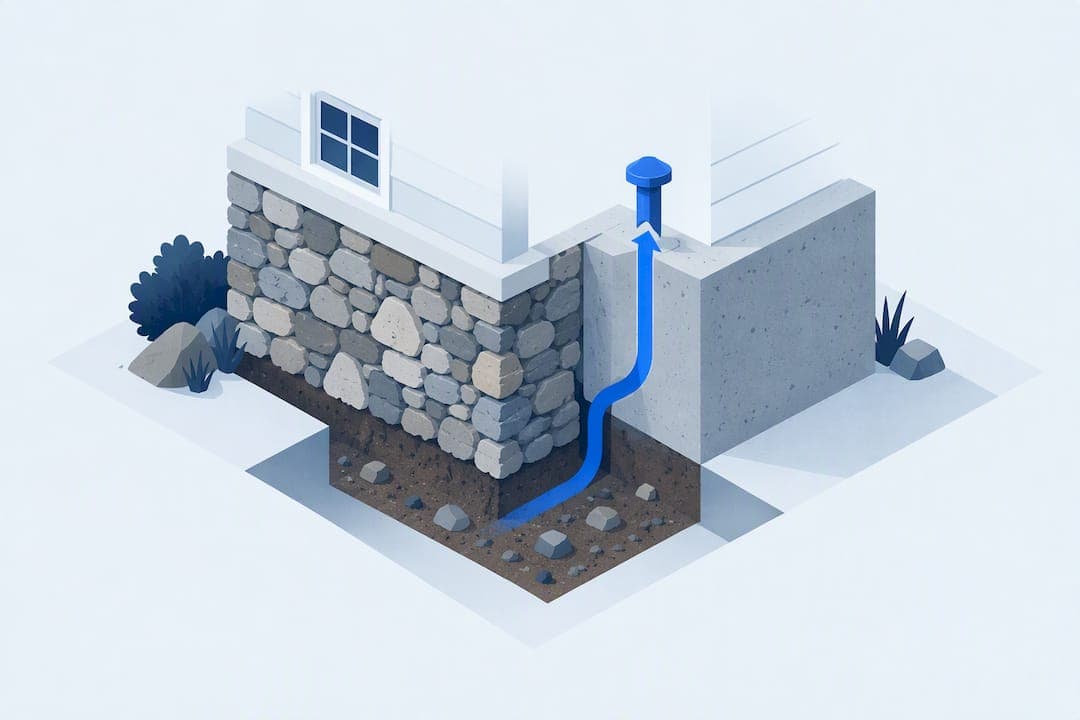
Old homes can and do have elevated radon, and the only way to know is to test. If a short-term test comes back at or above 4 pCi/L, follow up with a longer test to confirm, then arrange professional mitigation and verify the result once the system is running.
TL;DR:
- For short term testing, close windows and doors about 12 hours beforehand, avoid unusual fan use, and place the detector on the lowest livable level.
- Readings from 2 to 4 pCi/L warrant a second test and a mitigation discussion; below 2 pCi/L, retesting every few years remains reasonable.
- Active soil depressurization draws gas from beneath the foundation, but mixed stone, block, and poured sections may need separate suction points or methods.
- During a purchase, request documented post installation testing and make mitigation a written contingency; renovations can add a vapor barrier and capped vent pipe.
Table of Contents
- Radon Basics Every Older-Home Owner Should Understand
- Why Older Foundations Can Let in More Radon
- Testing an Older Home: Picking the Right Method and Timing
- What Your Results Actually Mean
- Mitigation Options That Actually Work in Old Foundations
- A Radon Checklist for Buying, Selling, or Renovating an Old House
- What a Qualified Mitigator Brings to an Older Home
- A Straightforward Take on Living With Radon Risk
- Get Your Older Home Tested and Protected
- FAQ
- Sources
Radon Basics Every Older-Home Owner Should Understand
Radon forms when uranium and radium naturally present in soil and rock break down, releasing a radioactive gas that seeps upward. It can also enter a house through well water in some regions. Once it reaches a foundation, it finds its way in through cracks, gaps around pipes and sump pits, unsealed joints, and porous masonry, then builds up indoors where ventilation is limited.
The health stakes are real. Radon is the second leading cause of lung cancer in the United States, and the EPA estimates it causes thousands of lung cancer deaths annually. That figure is why the agency recommends fixing a home at or above 4 pCi/L and stresses that there is no exposure level considered fully safe.
Why Older Foundations Can Let in More Radon
Age by itself does not create radon. Local geology drives how much radon is in the soil to begin with, but an older home's construction can make it easier for that gas to reach the rooms you live in. Several common features raise the odds:
- Fieldstone or rubble foundations with mortar joints that have loosened or crumbled over decades.
- Dirt-floor cellars with no vapor barrier at all.
- Additions joined to the original structure, creating seams where soil gas can travel unpredictably.
- Sump pits or hand-dug wells that sit open to the soil beneath the slab.
Tall, multi-story older houses can also experience a stronger stack effect, where warm air rising through the structure pulls soil gas up from the basement into living spaces. Practitioner observations on older housing stock note that these foundation characteristics correlate with higher indoor radon readings, though sealing joints alone rarely solves the problem long-term.
Pro Tip: If your basement has more than one foundation type, such as a stone section joined to a poured addition, mention both to whoever designs your mitigation system since each surface may need its own approach.

Testing an Older Home: Picking the Right Method and Timing
Testing is where every decision starts, and the method you choose depends on your timeline. The CDC outlines two main categories: short-term tests, run for 2 to 90 days, and long-term tests, run for more than 90 days to capture a full year-round average. For a quick check or a real estate transaction, a short-term test of at least 48 hours is standard.
- Close the house first. Begin closed-house conditions, keeping windows and exterior doors shut, about 12 hours before a short-term test starts, since skipping this step is a common reason DIY results get thrown out.
- Run the test without interruption. Avoid major HVAC changes or running exhaust fans more than normal during the testing window, per EPA measurement protocols.
- Place the detector in the lowest livable level. In a converted cellar, partial basement, or crawlspace turned storage room, place the device away from drafts, exterior walls, and moisture.
- Confirm elevated readings. If the first test comes back high, the EPA protocol calls for either a second short-term test or a long-term test to establish a reliable average before deciding on mitigation.
- Bring in a professional for transactions. A documented, third-party test carries more weight with buyers, sellers, and lenders than a retail kit, and our radon testing service is built around that kind of transaction-ready result.
What Your Results Actually Mean
A number on a report only matters once you know what to do with it. The EPA's guidance is specific: act at or above 4 pCi/L, and give serious consideration to fixing the home even in the 2 to 4 pCi/L range, since no level of radon exposure is considered risk-free.
- Below 2 pCi/L: generally low risk, though retesting every few years is still reasonable.
- Between 2 and 4 pCi/L: worth a second test and a conversation with a mitigation professional.
- At or above 4 pCi/L: the EPA recommends fixing the home, typically confirmed by averaging two short-term tests or running one long-term test.
Opening windows or running fans can lower a reading temporarily, but the CDC is clear that ventilation is a short-term measure, not a permanent fix, since it depends on you keeping windows open and does nothing to stop soil gas from entering in the first place.
Mitigation Options That Actually Work in Old Foundations
Active soil depressurization, or ASD, is the industry-standard fix, and for good reason: a properly designed ASD system can often reduce radon levels significantly. It works by drawing soil gas from beneath the foundation through a pipe and fan system before it ever enters the house, rather than trying to block every possible entry point after the fact.
Older homes with mixed foundation types often need a tailored version of this approach:
- Subslab suction works well under poured sections of a basement, including additions joined to an original stone foundation.
- Submembrane suction is used in crawlspaces, where a sealed plastic membrane covers exposed dirt and a fan draws gas from beneath it.
- Sump-pit suction adapts an existing sump basin into a collection point for the mitigation system, useful where a home already has one installed.
- Block-wall suction addresses hollow concrete block foundations that can act as a chimney for soil gas on their own.
Sealing cracks and joints improves how efficiently these systems perform, but on its own it rarely holds radon below the action level for long. Fieldstone basements sometimes need multiple suction points or exterior subslab drilling to reach all the soil beneath an irregular floor. Our radon mitigation systems are designed around each foundation's actual layout rather than a one-size-fits-all template, and fans typically need replacement every 5 to 10 years, which is why periodic verification testing matters even after a successful install.
Pro Tip: Ask your mitigator to route discharge piping along an existing wall line or through a utility space if preserving a historic exterior matters to you; a qualified installer can usually avoid visible changes to the original fabric.
A Radon Checklist for Buying, Selling, or Renovating an Old House
Radon decisions get more complicated once money and deadlines are involved. A short checklist keeps the process straightforward:
- Test the lowest livable level before listing or closing, since that is where radon concentrates most.
- Request documented verification testing if the seller already installed a mitigation system, confirming it is still performing before you close.
- Write a mitigation contingency into the purchase agreement and get a fixed, written quote from a qualified mitigator rather than a verbal estimate.
- Add radon-resistant features during any renovation, including a vapor barrier and a capped vent pipe stub, since the EPA notes these passive features are cheaper to build in than to retrofit and can be upgraded to an active system later just by adding a fan.
If a renovation also touches old window openings or foundation drainage, coordinating that work with your mitigation plan avoids redoing either job. Resources like Gepetto Millworks' historic window guidance and A-1 Basement Waterproofing's foundation repair overview are useful starting points if you are weighing historic preservation alongside structural and radon work.
What a Qualified Mitigator Brings to an Older Home
A mitigation system designed around your specific foundation performs more reliably than a generic install, especially when a house combines stone, block, and poured concrete under one roof. Site-specific measurement lets a mitigator choose the right suction points and pipe routing before any drilling starts, rather than guessing and adjusting later.

Documentation matters just as much as the install itself. Post-installation verification testing and written records protect everyone in a transaction, giving buyers, sellers, and homeowners proof the system is doing its job rather than just an assumption that it is. We provide fixed written quotes with no added costs after quoting, ANSI/AARST certified installations, and ongoing repair and fan replacement services so a system keeps performing years after the initial work.
A Straightforward Take on Living With Radon Risk
Radon sounds alarming until you realize how solvable it is. Testing is quick, mitigation is a mature technology, and a verified, documented fix gives you a result you can actually trust instead of a guess.
— Yoshua
Get Your Older Home Tested and Protected
We built our approach around the fact that older homes rarely have simple, uniform foundations, so every mitigation design starts with measuring your specific house rather than applying a standard template.

Our services cover radon testing, custom mitigation system design, verification testing, radon during a home sale, and repair or fan replacement for systems already in place. Every install comes with a fixed written quote, certified workmanship, and documentation you can hand to a buyer, lender, or insurer. Get a fixed quote on mitigation or schedule 48-hour radon testing to find out where your home stands.
This article is general information, not a substitute for advice from a qualified doctor. Consult a qualified healthcare professional about your own circumstances before acting on anything here.
FAQ
Do most old houses have radon?
Not necessarily. Radon levels depend mainly on the uranium and radium content of the soil beneath a house, so an old home on low-radon geology can test clean while a newer home nearby tests high. Age-related foundation features like loose stone joints or dirt floors can make entry easier, which is why testing rather than assuming is the only reliable approach.
How long can you be exposed to radon before you get sick?
There is no safe exposure window, since the EPA notes there is no known risk-free level of radon. Radon-related lung cancer risk builds with cumulative exposure over years, which is why health agencies recommend testing and fixing elevated levels promptly rather than waiting.
What houses are most at risk for radon?
Homes sitting on soil with higher natural uranium or radium content carry the highest baseline risk, regardless of age. Within that geology, houses with foundation gaps, such as unsealed joints, dirt-floor cellars, or exposed sump pits, tend to let in more soil gas, which is a pattern seen more often in older construction.
Does opening a window get rid of radon?
Opening windows can lower radon temporarily by diluting indoor air, but public health guidance treats this as a short-term measure, not a fix. It only works while the windows stay open and does nothing to stop soil gas from entering, so a permanent reduction requires a mitigation system like active soil depressurization.
Sources
- Health risk of radon | EPA
- Testing for radon | CDC
- Reducing radon in your home | CDC
- Indoor radon and radon decay product measurement device protocol | EPA archive