For apartment and multifamily properties, commission professional multifamily radon testing that follows ANSI/AARST protocols, and act on any confirmed reading at or above 4.0 pCi/L with design-level mitigation and verification. That means hiring qualified professionals, requiring a written sampling plan, confirming results before committing to a scope, and closing the project with clearance testing plus an operation and maintenance plan.
TL;DR:
- Sampling plans should be based on detection probability calculations rather than fixed percentage rules, ensuring all sectors and units with potential radon entry are tested properly.
- Confirmatory testing at or above 4.0 pCi/L is mandatory before mitigation, with retesting or expanded testing recommended depending on initial results.
- Mitigation typically involves sector-specific active soil depressurization systems, with proper documentation of HVAC interactions and sector diagrams required upfront.
- Verification testing must occur after system activation, with ongoing maintenance and retesting scheduled approximately every two to five years to ensure continued effectiveness.
- Proper qualification of professionals, detailed sampling protocols, and comprehensive documentation are crucial for compliance and financing approval in multifamily radon projects.
Table of Contents
- When and why to test a multifamily property
- How to design a defensible multifamily testing plan
- Interpreting results and deciding on confirmatory testing
- Mitigation approaches for apartments and multifamily properties
- Verification testing and O&M: proving systems stay effective
- Hiring and contract checklist for radon professionals
- Cost and timeline for testing and mitigation projects
- Health risks and symptoms of radon exposure for apartment residents
- Legal regulations and landlord responsibilities for radon in apartments
- Communication strategies for tenants about radon testing and mitigation
- Why tailored professional design matters more than a generic fix
- Request a multifamily radon assessment or written quote
- FAQ
- Sources
When and why to test a multifamily property
Several events should trigger multifamily radon testing regardless of whether a jurisdiction mandates it. HUD MAP applications are the clearest case: the HUD Mortgagee Letter guidance requires radon reports for many multifamily financing transactions and ties mitigation and follow-up testing to final loan endorsement. Beyond financing, testing before and after substantial rehab catches changes to the building envelope and slab penetrations that can shift radon pathways, and a sale or refinance often calls for a current report rather than an old one.
Some transactions allow a documented exception. Updated Freddie Mac guidance permits environmental consultants to waive testing where they can document low radon risk, but an undocumented assumption of low risk is not the same as a waiver on file.
- HUD MAP applications and other federally backed financing transactions
- Substantial rehabilitation, before and after construction
- Property sale or refinance due diligence
- Routine stewardship retesting on a fixed schedule, even with no transaction pending
Lenders generally accept a report faster when it already matches recognized protocols, which saves time at underwriting.
How to design a defensible multifamily testing plan
A sampling plan built only around a flat percentage rule is a common weak point. CDC's statistical analysis of percentage-based testing found that sampling 10% or 25% of ground-floor units often produces a low probability of catching a unit at or above 4.0 pCi/L in buildings with fewer than several dozen ground-floor units.
A sound procurement requires these steps from the testing contractor:
- Build the sampling plan from the MA-MFLB protocol, identifying every unique sector, all ground-contact locations, and upper-floor units where stack effect or shared ductwork could carry soil gas upward.
- Calculate sample size using a detection-probability target instead of a flat percentage, documenting the math in the proposal.
- Deploy devices simultaneously across all required locations, under closed-building conditions, for a minimum of about 46 to 48 hours.
- Choose continuous monitors or certified short-term devices appropriate to the sector, and record every device serial number against its location.
- Compile sample logs, lab reports, and the written protocol into a single file ready for lender or HUD review.
Pro Tip: Ask for the detection-probability calculation in writing before testing begins, not after a report comes back clean on too small a sample.
Our radon testing service follows this kind of documented approach rather than a generic percentage shortcut.
Interpreting results and deciding on confirmatory testing
A result at or above 4.0 pCi/L is the operational trigger EPA and HUD both point to for mitigation action, and confirmatory testing is the standard next move before committing to a full scope. HUD's MAP guidance ties mitigation and follow-up testing directly to loan endorsement timing, so a property with elevated readings cannot simply proceed as if the report were clean.
When an initial test returns at or above 4.0 pCi/L, owners typically face a few paths:
- Retest the specific unit or sector to confirm the reading before committing to design work.
- Expand testing to neighboring ground-contact units if the elevated reading suggests a broader sector issue.
- Move directly to mitigation design when the reading is well above the threshold or when a lender's timeline does not allow for a confirmatory round.
Lenders may require a mitigation plan, full mitigation, or both depending on how the findings are presented, so documenting the rationale behind each choice, along with its cost, protects the timeline at underwriting.
Mitigation approaches for apartments and multifamily properties
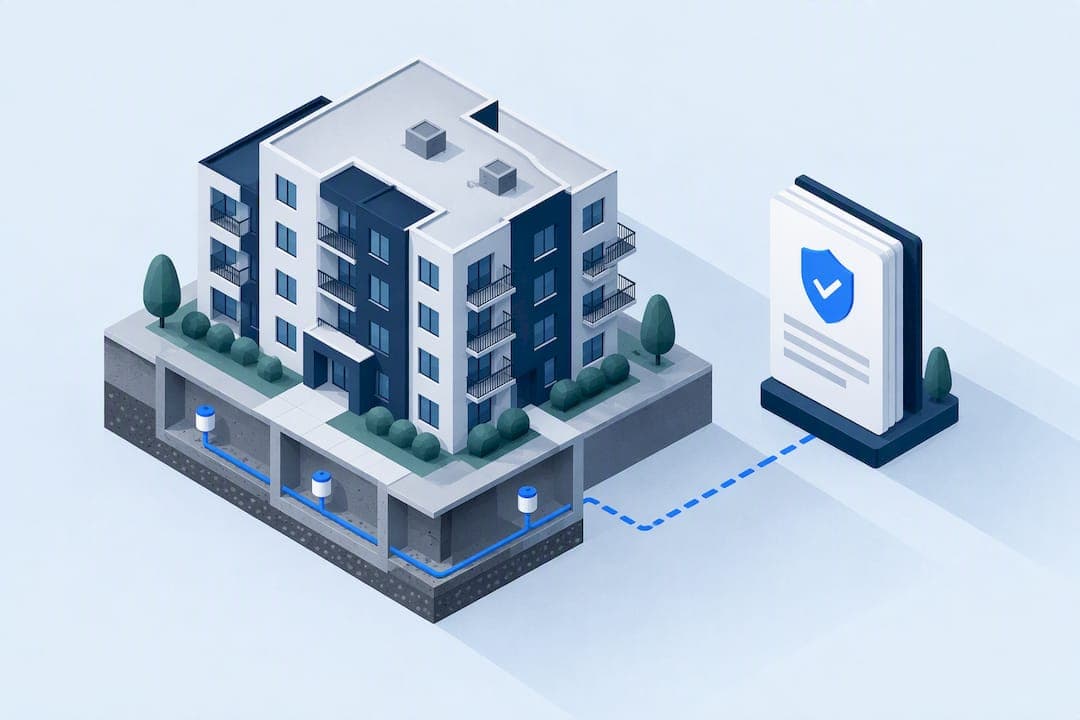
Mitigation for a multifamily building rarely looks like a single-family system scaled up. Active sub-slab depressurization remains the core technique, but it has to be adapted sector by sector, since a large slab often behaves like several separate foundations joined together. Building-pressurization adjustments and ventilation strategies sometimes supplement sub-slab work, and hybrid designs combining both are common where the foundation type varies within one structure.
- Multiple ASD systems or a sectorized design are often needed when ground-contact areas do not share a common sub-slab aggregate layer.
- Exhaust routing, roof penetrations, and other structural work add cost and require coordination with building ownership before installation.
- Shared HVAC systems can pull soil gas between units, which is why a competent design documents HVAC interactions alongside sector maps.
SGM-MFLB sets the mitigation design and documentation standard owners should mandate in any multifamily contract, including sectorization diagrams and approved device lists.
Pro Tip: Request sector diagrams and HVAC interaction notes as part of the mitigation proposal, not as an afterthought during installation.
Our radon mitigation systems are designed around each building's specific foundation and sector layout rather than a single standard template.
Verification testing and O&M: proving systems stay effective
A mitigation system is not finished until clearance testing confirms it works and an O&M plan keeps it working. SGM-MFLB sets the baseline: wait at least 24 hours after system activation, then monitor for a minimum of about 46 hours under closed-building conditions using an approved device.
- Run clearance testing on the timeline above and keep the lab report with the project file.
- Perform quarterly visual and fan checks to catch an obvious failure early.
- Complete biennial mechanical inspections of fans, piping, and seals.
- Retest mitigated locations roughly every 2 years, and run a full building clearance test about every 5 years, per SGM-MFLB guidance as a baseline.
- Log every inspection, retest, and repair in the O&M manual so a future owner or lender can see the system's full history.
A thorough O&M manual, backed by dated logs, is often what separates a financeable property from one stuck in extra underwriting questions.
Hiring and contract checklist for radon professionals
A proposal that skips credentials or documentation is a proposal to decline. HUD and lender guidance commonly reference the Qualified Measurement Professional designation, along with NRPP or NRSB certification and familiarity with current ANSI/AARST standards, as baseline requirements for multifamily testing and mitigation work. Check state licensure requirements as well, since they vary by jurisdiction.
- Require a written sampling protocol that cites MA-MFLB and shows the detection-probability math, not just a percentage.
- Require mitigation design drawings, a fixed written quote, and verification testing included in the scope, not billed as an extra later.
- Require a complete O&M manual and a documentation package formatted for lender or HUD file review.
Pro Tip: A proposal that quotes a flat 10% sample with no detection-probability discussion is a sign the bidder is not working from current multifamily standards.
Red flags include vague sector descriptions, no mention of post-installation verification, and a quote with no written protocol attached.
Cost and timeline for testing and mitigation projects
Testing costs scale with device type, the number of locations the sampling plan requires, and lab turnaround time, so a building with many unique sectors costs more to test properly than a simple, uniform slab. Mitigation costs track the number of ground-contact sectors needing their own system, overall system count, the complexity of roof or duct routing, any structural work, and permitting requirements in the jurisdiction.
- Testing typically runs a matter of days from deployment to lab report.
- Design and permitting for mitigation commonly take a few weeks, depending on the jurisdiction and building complexity.
- Installation can range from a few days to a few weeks depending on system count and access.
- Clearance testing follows a short wait after activation, then a monitoring period before the report is final.
Request a fixed quote that bundles verification testing and the initial O&M documentation rather than treating those as change orders. Our mitigation cost guide outlines the factors that typically drive a project's price.
Health risks and symptoms of radon exposure for apartment residents
Radon is a radioactive gas with no smell, color, or taste, which means residents cannot sense elevated levels without testing. The health concern is long-term: radon decay products lodge in lung tissue when inhaled, and sustained exposure to elevated levels raises lung cancer risk over time rather than causing acute symptoms right away. There is no short-term warning sign such as headaches or nausea that reliably signals a radon problem, which is exactly why testing, not resident report, has to drive decisions.
Apartment and condo residents face a specific wrinkle that single-family homeowners do not: exposure can vary significantly by floor and by unit, even within the same building, because radon enters primarily through ground contact and can also move through shared stack effects and ductwork. A ground-floor unit over a crawlspace or slab can show a very different reading than a unit three floors up, even when both sit in the same structure. That variability is part of why a sampling plan needs to cover unique sectors and upper floors where applicable rather than assuming one reading represents the whole building.

For owners and managers, the practical takeaway is that resident wellbeing depends on the same testing and mitigation discipline covered throughout this guide, applied consistently across every sector rather than treated as a single building-wide checkbox.
Legal regulations and landlord responsibilities for radon in apartments
Radon regulation for multifamily properties in the United States runs largely through financing and transaction requirements rather than a single nationwide landlord mandate. The clearest federal lever is HUD's MAP guidance, which requires radon reports for many multifamily financing applications and ties mitigation plus follow-up testing to final loan endorsement. Freddie Mac's updated guidance similarly sets minimum testing requirements for funded multifamily projects and allows a documented low-risk exception from a qualified environmental consultant, with follow-up testing required wherever a unit shows a result at or above 4.0 pCi/L.
Beyond financing-tied requirements, state and local rules on radon disclosure and testing vary, so an owner or manager should confirm the specific obligations in their jurisdiction before assuming a federal guidance document covers every local requirement. Where a property is financed or refinanced through a federally backed program, the Mortgagee Letter and related MAP standards function as a practical floor even in jurisdictions without their own radon statute.
For procurement purposes, the safest approach is treating ANSI/AARST protocols and HUD documentation standards as the baseline regardless of whether a specific transaction legally requires them, since that documentation is what lenders, buyers, and future owners will expect to see in the file. A qualified professional can also clarify which state licensure rules apply to a given property before work begins.

Communication strategies for tenants about radon testing and mitigation
Clear, early notice reduces confusion when testing crews need access to units. A short written notice explaining what radon is, why testing is happening, how long devices will be deployed, and what closed-building conditions mean for residents during the testing window heads off most questions before they arise. Explaining that elevated short-term readings do not mean immediate danger, but do require follow-up, helps residents understand the process without alarm.
Once mitigation work is scheduled, a second notice covering installation timing, expected noise or access needs, and the post-installation verification step keeps residents informed through to completion. Sharing the final clearance test result, once available, closes the loop and gives residents documented confirmation that the completed system meets the action threshold.
Consistent, dated communication also builds a paper trail that supports the broader documentation package lenders and future buyers may request, so treating tenant notices as part of the project file rather than a side task pays off later.
Why tailored professional design matters more than a generic fix
Multifamily radon work is not a scaled-up version of a single-family job. Every sector, foundation type, and HVAC connection changes the math on sampling and mitigation design, which is why a generic percentage-based test or a one-size system retrofit so often falls short in larger buildings.
Our focus at Cincinnati Radon Solutions is professional radon testing and mitigation, including ANSI/AARST certified installations and post-installation verification testing built into every project rather than sold as an add-on.
— Yoshua
Request a multifamily radon assessment or written quote
Getting a compliant sampling plan and a mitigation design that actually fits your building's sectors takes more than a form letter proposal. We offer multifamily radon testing, custom mitigation design built around each building's foundation and sector layout, verification testing, and O&M documentation formatted for lender and HUD file review.

If you manage a transaction timeline, a rehab schedule, or routine stewardship testing, request an assessment or a fixed written quote through our services page and we will scope the sampling plan before any work begins.
This article is general information, not a substitute for advice from a qualified doctor. Consult a qualified healthcare professional about your own circumstances before acting on anything here.
FAQ
What radon level requires mitigation in an apartment building?
A confirmed reading at or above 4.0 pCi/L is the common action level HUD and EPA guidance point to for multifamily mitigation. HUD's MAP guidance ties mitigation and follow-up testing to loan endorsement for many financing transactions at that threshold.
How many units in a multifamily building need radon testing?
Flat percentage rules such as testing 10% or 25% of ground-floor units often provide low detection probability in smaller buildings, according to CDC's statistical analysis. A defensible plan sizes the sample using a detection-probability target and the building's unique sectors rather than a flat percentage alone.
Who is qualified to test and mitigate radon in apartments?
HUD and lender guidance commonly reference the Qualified Measurement Professional designation along with NRPP or NRSB certification and current ANSI/AARST standards familiarity. State licensure requirements vary, so confirming local rules before hiring is part of due diligence.
How often should a mitigated apartment building be retested?
SGM-MFLB guidance recommends retesting mitigated locations roughly every 2 years and running a full building clearance test about every 5 years as a baseline stewardship schedule, detailed in the SGM-MFLB public review. Some intervals can be adjusted under standard provisions, but only with documented inspection history.
Does Cincinnati Radon Solutions handle multifamily and commercial properties?
Yes, our commercial and multi-family service line covers testing, custom mitigation design, and verification testing for apartment and multifamily buildings. Every mitigation project includes post-installation verification testing as part of the scope.
Sources
- Agencies change radon testing requirements as FHFA rescinds 2022 directive
- HUD Mortgagee Letter: Radon assessment and MAP guidance
- MA‑MFLB 2023 public review (Protocol for Conducting Measurements of Radon in Multifamily Buildings)
- Evaluation of percentage‑based radon testing requirements for federally funded multi‑family housing projects