
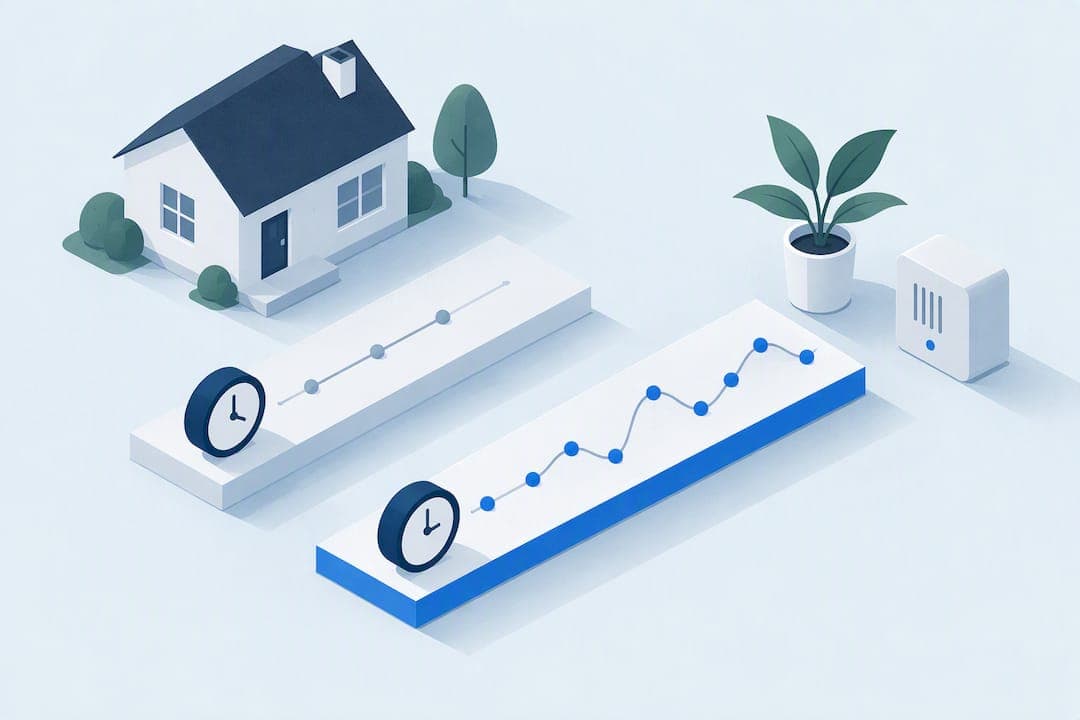
Short-term radon tests typically run 48 hours to about a week, though some devices extend to 90 days; long-term tests run longer than 90 days, often 6 to 12 months for an annual average. Every valid test needs at least 48 hours of deployment, and short-term tests shorter than four days require closed-building conditions for 12 hours beforehand.
TL;DR:
- For tests under four days, keep windows and exterior doors closed for 12 hours before placement and throughout; tests need at least 48 hours.
- At 4 pCi/L or higher, confirm with a second test or a longer test before mitigation; consider monitoring readings from 2 to 4 pCi/L.
- Place the detector on the lowest level used regularly, about 20 inches high, away from vents, drafts, exterior walls, and direct heat.
- Continuous monitors log hourly readings and provide results immediately, while passive canisters need lab processing that can take days or weeks.
Table of Contents
- Short-Term vs. Long-Term Testing: Duration Ranges and Device Types
- EPA and Protocol Requirements for a Valid Test
- How to Run a Valid Short-Term Radon Test
- What Affects Accuracy and Why Longer Tests Reduce Uncertainty
- Choosing the Right Duration and What to Do Next
- What Professional Testing and Verification Involve
- A Straight Answer on Speed vs. Accuracy
- Get Your Home Tested the Right Way
- FAQ
- Sources
Short-Term vs. Long-Term Testing: Duration Ranges and Device Types
The two test categories exist for different reasons, and the duration you pick should match what you actually need to know. Short-term tests cover a window from the 48-hour minimum up to 90 days, though most consumer kits sold for home screening run 2 to 7 days. Long-term tests run past 90 days, and the EPA points to roughly a year as the measurement that best captures seasonal swings in radon concentration.
Device choice tracks with duration:
- Passive charcoal canisters and electret ion chambers handle most short-term testing because they are inexpensive and simple to deploy.
- Alpha-track detectors are built for long-term measurement, often left in place for months.
- Active continuous radon monitors (CRMs) log hourly data and work for both short- and long-term testing, which is why inspectors favor them for time-sensitive jobs.
Real estate transactions almost always rely on short-term tests because closings do not wait a year for an answer. Homeowners who want a true picture of year-round exposure, especially in a home they plan to live in long-term, get more value from a long-term test or at least a second short-term test taken in a different season.
EPA and Protocol Requirements for a Valid Test
Results only mean something if the test followed the rules. The EPA's measurement protocols set 48 contiguous hours as the minimum deployment for any valid measurement, allowing a grace period down to slightly less than that duration in some cases.
Closed-building conditions matter just as much as timing:
- Windows and exterior doors should stay closed for 12 hours before a short-term test starts, and for the test's entire duration if it runs less than four days.
- Tests stretching toward a week still benefit from closed-building conditions, even though the requirement loosens slightly.
- Normal entry and exit through doors is fine, but prolonged openings skew results.
Short-term results at or above 4 pCi/L call for follow-up testing, either a second short-term test or a long-term test, before deciding on mitigation, according to EPA guidance. If a long-term test shows radon at or above this action level, mitigation is recommended.
How to Run a Valid Short-Term Radon Test
A short-term test is simple, but a handful of details separate a valid result from one you will have to redo.
- Choose the lowest level of the home that you use regularly, such as a basement family room, not an unfinished crawl space.
- Close all exterior windows and doors for 12 hours before placing the device.
- Record the exact start date and time when you set the device in place.
- Position it about 20 inches above the floor, away from drafts, exterior walls, vents, and direct heat sources.
- Avoid moving or disturbing the device for the entire test period.
- If running longer than 48 hours, end the test in 24-hour increments from your start time for cleaner data.
- Record the stop time, then reseal and ship passive devices to the lab promptly.
Weather plays a bigger role than most homeowners expect. High winds and major pressure changes from storms can pull more radon into a home or skew ventilation patterns, so avoid starting a short-term test right before severe weather if you can schedule around it.
Pro Tip: Set a phone reminder for your exact start time so the stop time lands precisely at 48 hours or a clean 24-hour multiple, which keeps your results defensible if a buyer or inspector questions them.
Passive canisters need lab processing that can take anywhere from a few days to a couple of weeks depending on the lab's turnaround. Continuous monitors skip that wait entirely, since they display or log results as soon as the test period ends.

What Affects Accuracy and Why Longer Tests Reduce Uncertainty
Radon levels are not static. They shift through the day and across seasons, which means a 48-hour snapshot taken in October might not represent what a sealed-up house looks like in January. Barometric pressure, wind, and heating patterns all push soil gas into a home at different rates.
Common mistakes that invalidate a short-term result include:
- Propping open a window or door during a test that requires closed-building conditions.
- Placing the device near an HVAC vent, exterior wall, or sunny window.
- Moving the canister mid-test to vacuum or clean the area.
A peer-reviewed comparison of winter short-term tests (7 to 10 days) against annual measurements found a strong correlation of 0.87, but the same research noted that short-term results can still misclassify some homes relative to their true annual average. That gap is exactly why longer measurement windows carry less uncertainty: they average out the daily and seasonal noise that a 48-hour test cannot smooth over. Continuous monitors add another layer of confidence because their hourly logs can reveal whether a closed-building rule was violated or whether a spike came from something unusual rather than a real baseline shift.
Choosing the Right Duration and What to Do Next
Match the test to the decision you are making. A home sale closing in two weeks calls for a short-term test. A family planning to stay in a house for years benefits more from a long-term test or a repeat short-term test in a different season.
Follow-up steps depend on where your number lands:
- At or above 4 pCi/L on a short-term test, run a second short-term test or a long-term test to confirm before mitigating.
- Between 2 and 4 pCi/L, consider retesting or switching to long-term monitoring for a clearer picture.
- Below 2 pCi/L, routine retesting every couple of years is generally enough.
Call a professional when your foundation is complex, when results come back inconsistent or unexpectedly high, or when you need verification testing after a mitigation system goes in.
What Professional Testing and Verification Involve
Professional testers lean on continuous radon monitors for real estate transactions because the hourly data holds up to scrutiny in ways a single canister reading cannot. A qualified tester documents the full process: placement, closed-building conditions, start and stop times, and any follow-up testing needed to confirm an initial result.
Verification testing after a mitigation system is installed follows its own timing rule: no sooner than 24 hours after the system starts operating, and completed within 30 days of installation, per EPA guidance.
We bring that same discipline to every job:
- We provide radon testing using protocols that hold up for real estate transactions and personal peace of mind alike.
- We design custom mitigation systems tailored to each home's foundation.
- We back every mitigation install with post-installation verification testing and certified installation standards.
Professional testing is especially valuable when timing is tight, when prior test results are unclear, or when official documentation is required for real estate transactions or lending.
A Straight Answer on Speed vs. Accuracy
Homeowners want a fast answer, and a 48-hour test gives you one. But speed and certainty are not the same thing. A short-term test tells you what radon looked like in your home for two or three days under specific conditions; a long-term test tells you what you are actually breathing all year. Neither is wrong, they just answer different questions, and conflating them is where most confusion starts. If your result lands anywhere near the action level, treat it as a prompt to gather more data, not a final verdict. Following the protocol matters more than the device you buy, and professional help is there if your situation gets complicated.
— Yoshua
Get Your Home Tested the Right Way
A radon test only means something if it is deployed and documented correctly, and that is exactly what we handle for homeowners across our service area. We provide radon testing built around EPA protocols, verification testing after mitigation, and custom-designed mitigation systems matched to your home's foundation.

Reach out to us when you are selling a home and need fast, defensible results, when your foundation is unusual, or when you need post-mitigation verification testing to confirm a system is working. Every quote is fixed and written, with no surprise costs added after quoting. If airflow or building envelope issues are contributing to elevated readings, pairing radon work with attic air sealing addressed by resources like this guide on blower door testing can help address the bigger picture.
Visit our services page to see the full range of testing and mitigation options, or check mitigation system pricing if you are already planning next steps after an elevated result.
This article is general information, not a substitute for advice from a qualified doctor. Consult a qualified healthcare professional about your own circumstances before acting on anything here.

FAQ
How accurate is a 48-hour radon test?
A 48-hour test is accurate as a screening tool when closed-building conditions are followed, and it correlates reasonably well with longer measurements. Research comparing short-term and annual tests found a strong correlation of 0.87, though short-term results can still misclassify some homes compared to their true annual average.
How often do homes fail radon tests?
There is no single published failure rate that applies to all homes, since results depend heavily on local geology, foundation type, and ventilation. The EPA recommends treating any result at or above 4 pCi/L as a signal to follow up rather than framing results as a pass or fail.
How long before you get sick from radon?
Radon-related health effects come from long-term exposure, not a short-term spike, which is why the health concern centers on cumulative lifetime exposure rather than a single day's reading. There is no safe threshold with a defined timeline for illness, so the practical response is testing and addressing elevated levels rather than waiting for symptoms.
How long do you leave a radon test in the house?
Short-term tests stay in place for a minimum of 48 hours, with most consumer kits running 2 to 7 days, while some device types extend up to 90 days. Long-term tests run past 90 days, often 6 to 12 months, to capture a full annual average.
Sources
- EPA — Radon publications, webinars and videos
- Indoor radon and radon decay product measurement device protocols (EPA archive)
- CDC / peer-reviewed study comparing short-term and annual radon measurements