
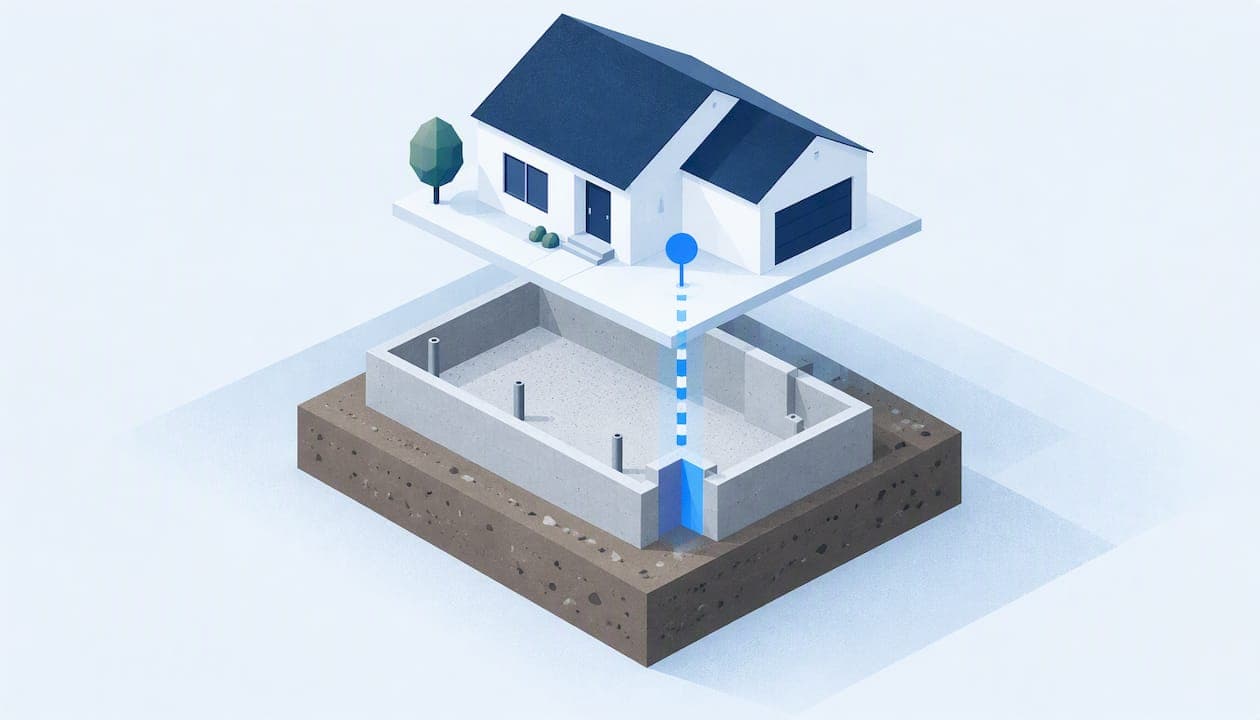
Yes, new homes can have radon. A new house is not exempt, and it can even be more prone to trapping soil gas because it is built tight. The CDC says radon can build up in any home, whether it has a basement, is sealed or drafty, or is new or old. The only way to know what is in your house is to test it after you move in, even if the builder installed radon-resistant features.
This guide explains why new construction is not a safe bet, what those radon-resistant features do and do not do, and what to do if you are buying, building or already living in a new home around Cincinnati.
TL;DR
- New homes can and do have elevated radon. Age, a sealed envelope and a modern foundation do not protect you.
- Radon-resistant new construction (RRNC) makes a home easier and cheaper to fix. It does not guarantee a result below 4.0 pCi/L.
- Test right after you move in, with a professional test if a sale is involved. Neighbors' results and soil tests cannot predict your house.
- If the result is 4.0 pCi/L or higher, have a qualified professional activate or install a system. Consider acting between 2.0 and 4.0 pCi/L.
- Rough-in during construction is the cheapest time to prepare a house for radon control.
Table of Contents
- Do new homes have radon?
- What radon-resistant new construction actually is
- Why you cannot predict a new house's radon level
- When and how to test a new home
- Buying a new or nearly new house
- For builders: preparing the house for a fan
- What happens if a new home tests high
- Our perspective: new does not mean verified
- Get a new home tested or fixed in the Cincinnati area
- FAQ
- Sources
Do new homes have radon?
Radon is a radioactive gas that comes from the natural breakdown of uranium in rock and soil. It moves up through the ground and enters a house through cracks, gaps around pipes, sumps and other openings in the foundation. EPA guidance for people building a new home describes the same entry routes in new houses as in old ones.
Two things make people assume a new house is safe, and both are wrong.
"It is new, so the foundation is intact." A foundation can be free of visible cracks and still have openings: utility penetrations, the joint where the slab meets the wall, a sump pit, a floor drain. Concrete also shrinks as it cures. Radon needs very little room.

"The house next door tested low." The CDC points out that two houses right next door to each other can have very different radon levels. Soil under each lot, how the site was excavated and backfilled, and how the house is ventilated all differ.
Tighter houses can hold more
Modern houses are built to leak less air, which saves on heating and cooling. The ATSDR clinician brief on radon notes that indoor levels tend to be higher than outdoor levels, and that this is especially true of newer construction that is more energy-efficient but can increase radon levels. A tight envelope does not create radon. It can reduce the fresh air that dilutes whatever does get in.
How common is a high result?
The EPA estimates that about 1 in 15 U.S. homes has an elevated radon level, 4 pCi/L or more. That figure is a national average. In an area with geology that favors radon, such as parts of Greater Cincinnati, the odds for an individual house can be higher, which is exactly why the individual test matters more than any average.
What radon-resistant new construction actually is
RRNC is a set of features added while the house is being built. The EPA lists them: a gas-permeable layer (usually clean gravel) under the slab, plastic sheeting over that layer, a sealed vent pipe running from under the slab up through the house and out the roof, and sealed cracks and openings in the foundation. An electrical junction box is typically placed in the attic near the pipe so a fan can be wired in later.
Here is how the parts work together:
| Feature | What it does |
|---|---|
| Gravel layer under the slab | Lets soil gas move freely so it can be collected rather than pushed up through cracks |
| Plastic sheeting | Keeps soil gas from seeping up through the slab and helps the gravel layer work as a collection zone |
| Vent pipe through the house and roof | Gives the gas a path to the outdoors |
| Sealed slab openings | Cuts down the number of entry points |
| Attic junction box | Allows a quick fan hookup if testing shows a problem |
Passive is not the same as solved
Without a fan, a passive system relies on the natural stack effect: warm air rising in the pipe creates a gentle pull. That pull can be weak or inconsistent, especially in mild weather. AARST, the association that develops radon standards, covers RRNC as a code topic because building codes decide how much of this work happens in the first place.
The EPA is direct on this point: even with radon-resistant features, it recommends testing a new home. If the result is 4 pCi/L or higher, the fix is usually to add a fan, which turns the passive system into an active one.
Why rough-in costs less than a retrofit
Running a pipe through open wall cavities and laying gravel before the slab is poured is far easier than cutting into a finished house. The EPA says it is significantly more cost-effective to build these features in than to add them later. Builders and buyers of custom homes should treat the rough-in as the cheapest radon insurance available, with the understanding that it still has to be verified by testing.
Why you cannot predict a new house's radon level
Zone maps and neighbors
EPA radon zone maps help local governments decide where to require radon-resistant features. They describe averages across a county. They do not describe your lot, your foundation or your furnace's effect on air pressure in the house. A home in a lower-potential area can test high, and one in a high-potential area can test low.
Soil testing before you build
Some builders and buyers consider testing the soil before construction. The EPA does not recommend it for deciding whether to build radon-resistant, because a soil test cannot rule out that radon will be a problem in the finished house. Excavation, backfill and the foundation itself change how gas moves. If you are building, putting in the passive features is the more dependable choice than paying to guess.
The only answer is a test in the finished house
The result that counts is the one measured inside your house, under normal living conditions, after it is occupied. That is also why we run a verification test after every mitigation system we install: a design is a prediction, and a test is the proof.
When and how to test a new home
- Test soon after you move in. The EPA recommends testing new homes after occupancy, whether or not radon-resistant features were installed.
- Keep closed-house conditions. Short-term tests are generally run with windows and exterior doors kept closed except for normal entry and exit. Your tester will give you the specifics.
- Test the lowest livable level. That means the lowest floor you use or could finish, such as a basement you plan to use as a living space.
- Read the result against the action level. The CDC advises contacting a qualified professional to install a reduction system at 4 pCi/L or above.
- Retest after any fix, and after major changes. Heating system changes, foundation work or finishing a basement can change results.
If you want a professional measurement with reporting that works in a real estate transaction, see our radon testing service.
What about a result between 2.0 and 4.0?
The CDC states there is no known safe level of radon. The 4.0 pCi/L action level is a point where the EPA advises action, not a line below which risk disappears. For a result in the 2.0 to 4.0 range, the guidance is to consider mitigation, particularly if your household includes children or smokers. A new home with passive features already in place is the easiest situation in which to act on a number like that, because the fan hookup is already planned.
Buying a new or nearly new house
Buyers of new construction often skip the radon conversation because the house comes with a builder warranty and a clean inspection. Do not. Ask the builder:
- Were radon-resistant features installed, and can I see the plan or photos from before the slab was poured?
- Has the house been tested, by whom, and when?
- Is there a junction box in the attic, and is the vent pipe sealed and labeled?
- If the result is high, who is responsible for the fan and for retesting?
The EPA's buyer and seller guide suggests asking exactly these questions. Get the answers in writing, and schedule your own test rather than relying only on a builder's report.
Timing matters. A radon result that comes back high late in the process can slow a closing, so it helps to plan the test early. This real estate perspective on radon and closing delays comes from a Maine brokerage, so the local numbers are not ours, but the lesson on timing carries over to any market.
For sellers, a documented test and, where needed, a verified mitigation system make the file cleaner for buyers and agents. We cover this through our home sale radon work, listed on our services page.
For builders: preparing the house for a fan
If you build homes in the Cincinnati area, the rough-in is where radon work is simplest. A few practical points:
- Get the gravel layer and sheeting right. A continuous, uninterrupted gas-permeable layer is what lets a fan later pull from under the whole slab. Foundation type matters, and a basement, slab-on-grade and crawl space need different designs.
- Seal the slab. Seal control joints, utility penetrations and the perimeter, and cap or seal sumps.
- Run the pipe in conditioned space where you can. Keep it vertical and accessible, with clear labeling.
- Install the attic junction box. It costs little and saves a visit from an electrician later.
- Plan for the fan, not just the pipe. Think about where the fan will sit (outside living space, typically the attic) and where the exhaust will terminate.
As with any building-envelope detail, radon prep sits alongside ventilation planning. This explanation of why ventilation matters in a remodel is a useful reminder that air movement in a tight house needs to be planned, not left to chance.
Standards are the backstop. Our installations are ANSI/AARST certified, and the same standards inform how rough-ins are laid out so that a later fan activation works the way it should. If you want to see how we think about site-specific design, read our piece on radon system design starting with foundation tests.
What happens if a new home tests high
An elevated result in a new house is a fixable problem, and often an easier one than in an older home.
If the home has a passive system: a professional can evaluate the vent pipe, confirm it is intact and sealed, and add a fan at the junction box. Then you retest to confirm the number came down.
If the home has no radon-resistant features: a mitigator designs an active system for your foundation, commonly a sub-slab suction setup with a fan and a vent pipe discharging above the roofline. A site visit determines where the suction points should go.
Either way: insist on a post-installation test. A system that runs but has not been verified is a guess. If you are comparing costs, our radon mitigation cost guide explains what drives them in this area, and you can read about the mitigation systems we install.
Already have a system and wonder whether it still works? Fans can fail, and a quiet house is not proof of a working system. Our system repair and fan replacement service covers that.
Our perspective: new does not mean verified
We do radon work in Greater Cincinnati every day, and the most common mistake we see in new construction is treating the builder's checklist as the finish line. A pipe through the roof and a junction box in the attic are good bones. They are not a result.
What we believe, and how we work:
- Measure, then design. A system should be designed for the specific foundation and the specific house, not copied from the last job.
- Verify every time. Every mitigation we install includes post-installation verification testing, and you receive documentation suitable for a real estate transaction.
- Quote it in writing. Our quotes are fixed and written, with no added costs after quoting.
- Do one thing. Radon is our exclusive focus, which is why we are comfortable telling a homeowner that their passive system just needs a test, when that is the honest answer.
If you own a new house, test it. If it is fine, you have peace of mind and a baseline. If it is not, you have found a problem at the cheapest point to fix it.
— Yoshua
Get a new home tested or fixed in the Cincinnati area
We test and mitigate in Hamilton County, Butler County, Northern Kentucky and the rest of the Greater Cincinnati area. Whether you just closed on a new build, are about to, or are building one, start with a professional radon test. If the result calls for action, we design the system for your foundation and verify it afterward. You can also contact us through our main site for rough-ins on new builds, or see our local pages for Cincinnati and Northern Kentucky.
FAQ
Do new homes have radon?
They can. Radon enters through the foundation of any house, and the CDC states that both old and new homes can have radon problems. Testing is the only way to know your house's level.
If my new home has a radon-resistant system, do I still need to test?
Yes. A passive system makes it simple to add a fan, but it does not guarantee a result under 4.0 pCi/L. The EPA recommends testing new homes after occupancy whether or not those features were installed.
Can I test the soil before I build to find out if I need radon features?
The EPA does not recommend it for that decision, because a soil test cannot rule out a radon problem in the finished house. If you are building in an area with radon potential, building in the passive features is the more reliable approach.
What radon level is too high?
The EPA action level is 4.0 pCi/L, and the CDC advises contacting a qualified professional at or above that level. There is no known safe level, so a result between 2.0 and 4.0 pCi/L is worth discussing with a mitigator, especially if children or smokers live in the home.
Is a new house more likely to have radon than an older one?
Not necessarily, but it is not less likely. Newer homes are tighter, which can let radon accumulate when it does get in, and the ATSDR notes this for energy-efficient construction. Your own test is the only measure that matters.
Sources
- CDC: Radon and Your Health
- CDC: Reducing Radon Levels in Your Home
- CDC: Test Your Home for Radon fact sheet
- EPA: How to Address Radon When Building a New Home
- EPA: Should I test the soil for radon before building?
- EPA: Home Buyer's and Seller's Guide to Radon
- ATSDR: Clinician Brief on Radon
- AARST: Building Codes and Standards