If testing shows radon at or above the EPA action guideline in any regularly occupied area, commercial radon mitigation is warranted, and some facility managers choose to act at somewhat lower levels in high-use or sensitive spaces. A single canister in one room will not tell you enough. Commercial buildings need multi-location diagnostics and an engineered, multi-zone system, not a residential-style single fan. The next step is scheduling multi-point testing with a certified professional.
TL;DR:
- EPA recommends action at 4 pCi/L; consider mitigation between 2 and 4 pCi/L in heavily occupied or sensitive spaces because no exposure level is risk free.
- Testing across multiple locations under normal HVAC and occupancy conditions can distinguish isolated rooms needing local mitigation from clusters that point to a shared pathway.
- For readings above 20 pCi/L, EPA guidance identifies active depressurization beneath the slab as particularly effective; ventilation can raise energy costs and affect comfort.
- Short tests last 2 to 90 days, long term tests last at least 90 days, and continuous monitors capture daily HVAC and occupancy fluctuations.
- Before hiring, require a written zone by zone scope, proof of state licensing or AARST qualification, and post installation verification testing.
Table of Contents
- When commercial buildings need mitigation: thresholds and risk-based triggers
- How commercial mitigation systems work: methods and when each applies
- Diagnostics and testing strategy for commercial properties
- Designing installations that minimize disruption and last
- How we approach commercial radon mitigation
- Prioritizing mitigation across a property portfolio
- Getting started with a certified mitigation contractor
- FAQ
- Sources
When commercial buildings need mitigation: thresholds and risk-based triggers
The EPA recommends taking action when indoor radon reaches 4 pCi/L or higher, a guideline developed for residential exposure but widely applied to commercial and institutional buildings as well. There is no level considered entirely free of risk, which is why some property owners choose to mitigate frequently occupied spaces, such as daycare rooms, classrooms, or staffed offices, when readings fall between 2 and 4 pCi/L rather than waiting for the higher threshold.

Commercial buildings complicate this picture because radon rarely behaves uniformly across a footprint. A basement mechanical room might read 1.5 pCi/L while a ground-floor office fifty feet away reads 6 pCi/L, depending on slab conditions, HVAC pressure zones, and occupancy patterns. A short-term, single-canister test, adequate for a small home, misses this variation entirely in a large structure.
Interpreting multi-zone results takes judgment:
- A single elevated reading in an isolated room may call for localized mitigation rather than a building-wide system.
- Elevated readings clustered across several zones usually point to a shared soil-gas entry pathway and justify an engineered, building-wide design.
- Inconsistent results across similar spaces often signal HVAC pressure differences worth investigating before finalizing a mitigation plan.
There is also a regulatory gap worth understanding. As ATSDR notes, no federal law mandates radon mitigation in commercial buildings, including workplaces. That makes thorough testing and documentation a matter of practical liability management, not just compliance, since there is no enforceable standard to point to later if a tenant or employee raises a concern.
How commercial mitigation systems work: methods and when each applies
Most commercial projects draw from three approaches, often combined, rather than a single fix.
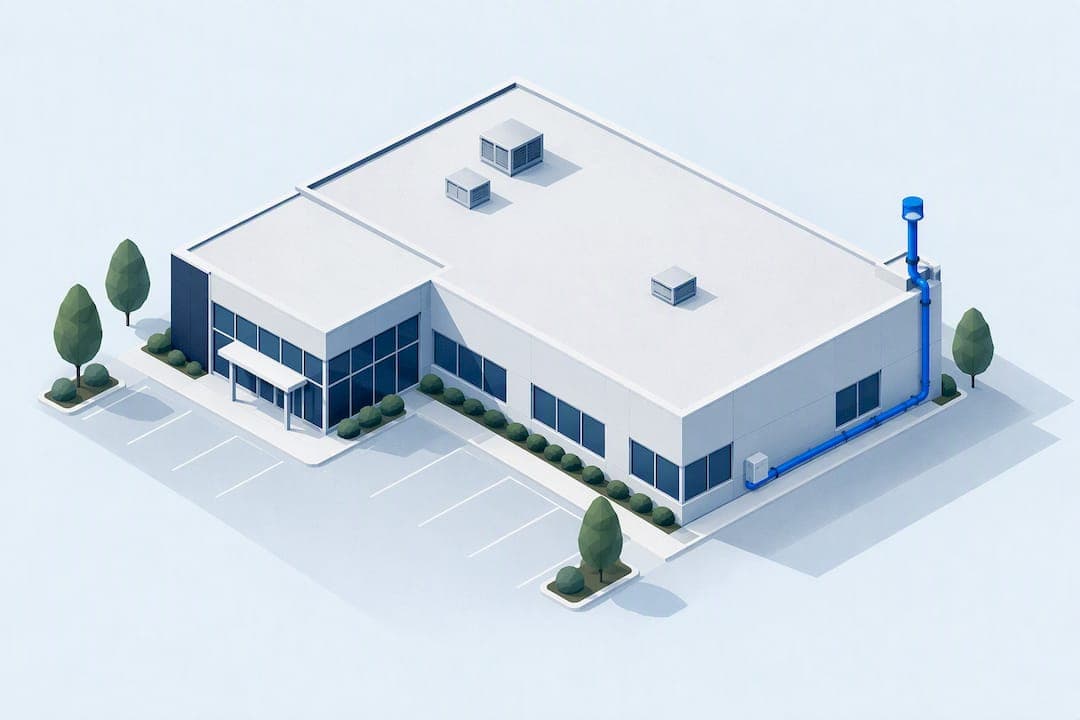
Active sub-slab depressurization (ASD) is the backbone of most commercial mitigation work. A fan draws soil gas from beneath the foundation through a network of suction points and vents it safely above the roofline before it can enter occupied space. The EPA's mitigation guidance identifies ASD as the most effective method available, and it is particularly reliable even at high starting concentrations.
HVAC-based pressurization or increased ventilation can supplement or, in some cases, substitute for ASD, especially in buildings where the mechanical system already manages large volumes of outdoor air. This approach has trade-offs: pushing more outdoor air through a building increases energy costs and can affect occupant comfort, so it typically requires an HVAC engineer to confirm the system has the capacity before relying on it as a primary strategy.
Larger or structurally complex buildings often need multi-zone engineered designs:
- Multiple suction points tied into separate sub-slab piping runs when a footprint spans several foundation types.
- Zone-specific fans sized to the soil and slab conditions under each section.
- A mix of ASD and HVAC strategies where neither alone covers every zone.
Pro Tip: Sealing cracks and penetrations improves how efficiently a system distributes suction under the slab, but sealing alone, without active depressurization, rarely brings levels into an acceptable range on its own.
According to EPA school and large-building guidance, active sub-slab depressurization is particularly effective when initial radon levels exceed 20 pCi/L, which is why high starting readings usually point straight to ASD rather than ventilation adjustments. Whatever method is chosen, post-installation verification testing confirms the system is performing before anyone treats the project as finished.
Diagnostics and testing strategy for commercial properties
A reliable mitigation design starts with diagnostics, not guesswork. The workflow generally looks like this:
- Place monitors at multiple points across the building footprint, prioritizing ground-floor and basement rooms with the highest occupancy, since a single device cannot represent a multi-zone structure.
- Choose the right monitoring duration: short-term tests (2 to 90 days) give a fast snapshot, long-term tests (90 days or more) better capture seasonal variation, and continuous monitors track fluctuations tied to HVAC cycling and occupancy throughout the day.
- Run diagnostics under normal operating conditions, meaning HVAC systems cycling as they normally would and typical occupancy patterns in place, since testing with systems off or a building empty can understate real exposure.
- Use the resulting data to decide whether ASD, HVAC pressurization, or a combined multi-zone design fits the building, rather than defaulting to one method.
Continuous or multi-location monitoring is especially valuable in commercial settings because levels can vary by room and by time of day in ways a single short-term test will miss. When requesting proposals, ask for defined scope, a written reporting format, and a post-install verification plan, and confirm the technician performing diagnostics is state-licensed or AARST-qualified. Our radon testing services are built around this kind of multi-point approach rather than a single canister drop.
Designing installations that minimize disruption and last
Commercial buildings rarely sit on one foundation type. A structure with a slab section, a crawlspace wing, and a basement addition needs routing strategies tailored to each, which is part of why commercial designs take more planning than a residential retrofit.
HVAC coordination matters just as much as the slab work. A mitigation fan that creates negative pressure in the wrong zone can pull conditioned air, or worse, radon, into unintended spaces, so larger projects often call for an HVAC engineer to review how the mitigation system interacts with existing air handling before installation begins.
Practical considerations for minimizing disruption include:
- Scheduling intrusive work (core drilling, piping runs) during low-occupancy hours or planned closures.
- Routing exterior piping and fan placement to avoid walkways, loading areas, or tenant sightlines.
- Confirming site access and any required permits before crews arrive.
- Mounting fans where they remain accessible for future service rather than buried behind finished work.
Pro Tip: Ask your contractor to include an operations, maintenance, and monitoring (OM&M) schedule in the proposal, covering fan inspection intervals, alarm or gauge checks, and a retest cadence, so performance does not quietly degrade over time. Our fan replacement and repair services exist largely because systems installed without an OM&M plan tend to get forgotten until a fan fails.
How we approach commercial radon mitigation
We design every commercial mitigation system around the specific foundation and layout we find on site rather than applying a standard residential template, and we confirm results with post-installation verification testing on every project. Operating in a region significantly affected by radon due to local geology, we treat testing and mitigation as essential protection against a known cause of lung cancer, not an optional upgrade.
Our installations are ANSI/AARST certified, meeting the industry's recognized standards of practice for mitigation work. We also provide transparent, written pricing and direct communication throughout a project, which matters when a facility manager needs to explain costs and timelines to ownership or tenants. For buildings with systems already in place, we handle repair and fan replacement so existing mitigation keeps performing as designed:
- Site-specific system design matched to actual foundation and soil conditions.
- Post-installation verification testing on every completed project.
- ANSI/AARST certified installation practices.
- Transparent, written pricing with dedicated communication.
- Repair and fan replacement support for systems already in service.
Prioritizing mitigation across a property portfolio
With multiple buildings to manage, start with spaces carrying the highest stakes: daycare centers, medical offices, and any area with persistent readings at or above 4 pCi/L. Those come before buildings with borderline numbers in low-occupancy storage areas.
Schedule intrusive diagnostic and installation work during off-hours or planned closures to limit disruption, and keep a clear record of every test result, decision, and completed mitigation. That documentation protects you later if a tenant, buyer, or regulator asks what you knew and when you acted on it. A commercial property document checklist is a useful reference for organizing these records alongside other property files.
— Yoshua
Getting started with a certified mitigation contractor

The path from an open question to a protected building is short: request multi-point diagnostic testing, review a written, site-specific mitigation proposal, and schedule installation with post-install verification included from the start. Before signing anything, confirm the proposal spells out:
- Full scope of work, including every zone being addressed.
- A fixed quote with no added costs after signing.
- Proof of ANSI/AARST certification for the installing technician.
- A defined verification testing plan once the system is running.
If you manage a mixed-use or multi-tenant property and want to understand what a scoped, written quote looks like for your specific building, our commercial and multi-family services page is the place to start that conversation.
This article is general information, not a substitute for advice from a qualified doctor. Consult a qualified healthcare professional about your own circumstances before acting on anything here.
FAQ
Is it safe to occupy a building with radon mitigation installed?
Yes. A properly functioning mitigation system is specifically designed to keep radon levels below the EPA's action guideline, and post-installation verification testing confirms it is working as intended. Routine retesting on a regular cadence keeps that assurance current over time.
What month is radon the highest?
Radon levels tend to run higher in colder months because closed windows and increased heating create stronger pressure differences that pull more soil gas indoors. This is part of why long-term or continuous monitoring gives a more complete picture than a single short-term test taken in only one season.
Is a radon level of 3.5 pCi/L considered high?
Some readings fall below the EPA's 4 pCi/L action guideline, but they are close enough that some property owners choose to act, particularly in heavily occupied or sensitive spaces like daycare rooms or medical offices. No level is considered entirely risk-free, so the decision often comes down to how the space is used.
How long does it take for radon levels to drop after mitigation?
A properly installed and functioning sub-slab depressurization system typically reduces radon levels within hours to a few days of operation, though verification testing is the only reliable way to confirm the drop at a given property. Ongoing performance depends on consistent fan operation and periodic retesting.