
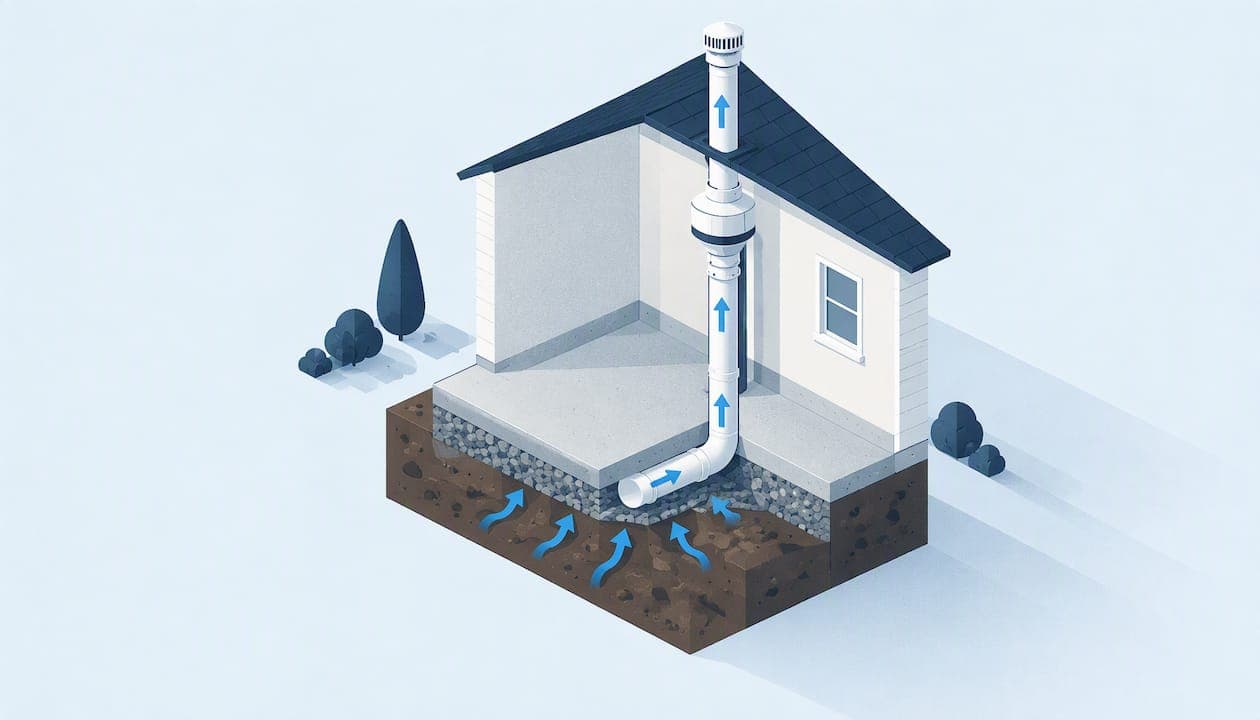
The most effective radon mitigation method for most homes is active soil depressurization (ASD): a pipe and an in-line fan that pull radon from the soil under your foundation and vent it above the roofline, before it can enter the living space. What changes from house to house is where the pipe draws from: under a concrete slab, from a drain-tile loop, from beneath a crawl space membrane or from inside hollow block walls. This guide explains each method, when it fits, what sealing can and cannot do, and how to tell a well-designed system from a guess.
TL;DR
- Active soil depressurization is the standard approach. Reductions can reach 99% when the system suits the foundation.
- The four main variants are sub-slab, drain-tile, sub-membrane and block-wall suction. Many homes need a combination.
- Sealing cracks alone does not fix a radon problem. It only supports a suction system.
- Design should come from diagnostic testing, and every system should be proven with a verification test afterward.
- Hire a contractor who does radon mitigation as their core work. In Ohio, radon professionals must be licensed by the state.
Table of Contents
- How radon gets in, and why suction works
- The main radon mitigation methods
- Which method fits which foundation
- What about sealing cracks, ventilation and other approaches?
- Design starts with diagnostics, not guesswork
- Where the pipe, fan and exhaust go
- Proving the system works
- Radon in Cincinnati: why local conditions matter
- Our perspective
- Getting a system designed for your home
- FAQ
- Sources
How radon gets in, and why suction works
Radon is a radioactive gas that forms as uranium in soil and rock breaks down. Your house acts like a weak vacuum. Warm air rises and leaks out near the top, so the lower levels pull air, and soil gas with it, through slab cracks, floor drains, sump pits, gaps around pipes and porous block walls. The EPA's consumer guide notes that some techniques prevent radon from entering while others reduce levels after it has entered, and that it generally recommends methods that prevent entry.
Suction does exactly that. A fan creates lower pressure under the foundation than inside the house, so the flow reverses. Soil gas is intercepted and sent outside instead of being pulled in. The key design question is how far that low-pressure zone reaches beneath the building. That is why the different methods exist: each is a way of connecting the fan to the part of the foundation where the air can actually be pulled.
The stakes justify getting it right. Radon is the second leading cause of lung cancer after smoking, and there is no known safe level. The EPA's 4 pCi/L action level is a point where fixing is clearly recommended, not a line below which risk disappears. The agency's 2025 benefit-cost analysis found a net benefit of $7.38 to $15.27 for every dollar spent mitigating existing homes above that level.
The main radon mitigation methods
A state training unit from the Florida Department of Health lists the standard ASD families: sub-slab, drain-tile, sub-membrane and block-wall depressurization, plus combinations. Here is how each works in practice.
Sub-slab depressurization
This is the workhorse for basements and slab-on-grade homes. A installer cuts a small hole in the concrete floor, removes a bucket of soil or aggregate to create a suction pit, and seals a vertical pipe into it. The pipe runs up through the house or along an exterior wall, passes the fan, and exhausts above the roof edge or at a safe location outside.
Fits best when: the soil or gravel under the slab is reasonably permeable, so suction spreads across the floor.
Watch for: dense clay, footings that divide the slab into separate zones, and finished basements where the pipe route needs planning. Tight clay is common in Southwest Ohio, so a single suction point is not always enough and a second may be needed.
Drain-tile depressurization
If a home has a perimeter drain-tile loop around the footing that feeds a sump pit, the loop can serve as a ready-made suction network. The sump is fitted with an airtight lid, and the pipe and fan pull from the pit and, through it, from the whole loop.
Fits best when: a working interior or exterior drain system exists and the sump can be sealed.
Watch for: sump lids need a tight gasket, and any open floor drain or water discharge line that connects to the system must be trapped or sealed so the fan does not pull room air instead of soil gas.
Sub-membrane depressurization
Crawl spaces with dirt floors need a different approach. The installer lays a heavy plastic membrane over the soil, seals it to the walls and piers, and connects a pipe and fan underneath it. The fan pulls radon from the soil under the plastic, and the membrane keeps conditioned air from being drawn down at the same time.
Fits best when: the crawl space has exposed earth or a rough floor that can be covered.
Watch for: seam sealing and perimeter sealing are what make or break the result. A torn or loosely taped liner will not hold suction. We cover this in depth in our guide to verified crawl space radon mitigation.
Block-wall depressurization
Hollow concrete block foundation walls act like a network of chimneys, carrying soil gas up the cores. In block-wall depressurization, suction is applied to those cores, often by drilling into the wall or sealing the top course and connecting a pipe. It is commonly paired with sub-slab suction, because gas can reach the wall from the slab edge and the footing.
Fits best when: a basement has hollow block walls with measurable radon coming from the cores.
Watch for: unsealed openings at the top of the wall and at the wall-to-slab joint. These need closing so suction is not wasted.
Combination systems
Older Cincinnati houses often have additions, a basement under one part and a crawl space under another, or a slab poured against a block wall. One method will not reach all of it. A combined system might use a sub-slab pit in the main basement, a membrane in the crawl space and a shared fan, or two separate fans where the pressure fields do not connect. Combination designs are normal, not a sign something went wrong.
Which method fits which foundation
| Foundation or feature | Typical method | Key design concern |
|---|---|---|
| Poured concrete basement | Sub-slab suction | Permeability of the material beneath the slab |
| Slab-on-grade | Sub-slab suction | Pipe routing, often through a garage or closet |
| Basement with sump and drain tile | Drain-tile suction, often with sub-slab | Airtight sump lid, sealed floor drains |
| Dirt-floor crawl space | Sub-membrane suction | Continuous, well-sealed liner |
| Hollow block walls | Block-wall suction, plus sub-slab | Sealing the top of the wall and joints |
| Mixed foundation | Combination | Separate pressure fields, possibly multiple fans |
This tailoring is what federal health agencies describe. The ATSDR clinician brief makes clear that outcomes depend on matching sub-slab, sub-membrane or drain-tile suction to the specific foundation and ground conditions.
What about sealing cracks, ventilation and other approaches?
Sealing alone is not a fix. The EPA consumer guide finds that sealing cracks and openings does not consistently or significantly lower radon levels by itself. It is useful as a supporting step that makes a suction system work better, because fewer leaks mean the fan has less air to move and the pressure field reaches farther.
Ventilation and air exchange can dilute radon temporarily, but they depend on windows, mechanical equipment and weather. They also increase heating and cooling costs, so they are rarely the primary answer for a basement with a real problem.
Passive systems use the same pipe without a fan, relying on natural stack effect. They are common as rough-ins in new construction. Because they rely on temperature differences rather than a fan, they are generally weaker. The usual practice is to test after the home is occupied and add a fan if the number calls for it. New builds are far easier to protect, because pipe and a gravel layer can be placed before the slab is poured.
Air cleaners and fans that stir room air do not address the source, and we do not consider them a mitigation method.
Design starts with diagnostics, not guesswork
The old approach, sometimes called poke and hope, is to drill one hole, install a standard fan and see what happens. A more careful method uses diagnostics. One example is pressure field extension testing, where the installer applies suction at a test point and measures small pressure changes at holes drilled elsewhere in the slab. The result shows how far suction travels beneath the floor, and so where suction points should go and how strong the fan needs to be.

This matters for two reasons. First, it reduces callbacks, because a weak system is spotted before it is built. Second, it avoids overspending: a home with loose, gravelly fill may need one pit and a modest fan, while a tight-clay house may need several points or a stronger fan.
When you collect quotes, ask:
- Where will the suction points go, and why there?
- How will you check that suction reaches the far corners of the slab?
- What happens at the sump, floor drains, and any block walls?
- Where will the pipe run, and where does it exhaust?
- How will the system be tested afterward, and what happens if the result is still high?
Where the pipe, fan and exhaust go
Details of the installation affect both performance and how you live with the system.
- Fan location. The fan should sit outside the living space, typically in the attic, in the garage or on the exterior, so any leak in the pressurized pipe does not release radon indoors.
- Exhaust point. The pipe should discharge above the roof edge, away from windows, doors and other openings, so the extracted gas disperses outdoors.
- Monitoring. A manometer or other gauge on the pipe shows whether the fan is running. A fan can fail without any noise, so a quick glance at the gauge is a useful habit. If it reads zero, see our checklist on what to do when mitigation seems not to be working.
- Labeling. The pipe should be marked as a radon system so later contractors do not cut into it.
- Electrical. Operating a typical fan is a modest, continuous load. It runs around the clock, so it should be installed with a proper electrical connection.
Fans do wear out. When one fails, replacement is a straightforward job, and our radon system repair and fan replacement service covers that along with checks of the rest of the system.
Proving the system works
Installation is not the finish line. A verification test, run after the fan has been operating, confirms the indoor level is actually down. The CDC describes follow-up testing as part of the process, and advises retesting after major remodeling or repairs, since changes to the house can alter pressure and airflow.
Timing also matters when you read results. Indoor radon tends to be higher in fall and winter, when houses are closed up. A CDC analysis of tracking data found mean levels of 203.8 Bq/m³ in January against 129.5 Bq/m³ in July. A test taken in July can understate what you will see in January, so it pays to be conservative with a borderline summer result. If you are interpreting your own numbers, our guides to confirming test results near 4 pCi/L and why a 48-hour test may not be enough explain what to look for.
Radon in Cincinnati: why local conditions matter
Hamilton County is in EPA Radon Zone 1, the category for counties with predicted average indoor levels above 4.0 pCi/L. The same page reports that Ohio requires radon professionals to be licensed by the Ohio Department of Health, so check a contractor's license before you sign anything. It also stresses that neighboring homes can differ widely, which is why you test your own house rather than relying on the neighborhood average.
The CDC warns that contractors who do not specialize in radon reduction can lack the skills and may even worsen the problem by misapplying techniques. A general contractor or handyman installing a fan on a pipe is not the same as a team that designs around your foundation.
Our perspective
We do one thing: radon testing and mitigation in the Greater Cincinnati area. That focus shapes how we think about methods.
First, we do not start with a favorite system. We start with the house. A poured basement with a sump, a block-wall foundation with a crawl space addition, and a slab-on-grade ranch each tell us something different about where suction will work. We measure the site and design for it, then put the plan in a fixed written quote, with no added costs after quoting.
Second, we treat the verification test as part of the job, not an extra. Every mitigation we install includes post-installation verification testing, and the documentation is suitable for real estate transactions. If a system has not been proven, it has not been finished.
Third, we believe the goal is the lowest level reasonably achievable, not scraping just under 4 pCi/L. Because no level is known to be safe, a design that leaves margin makes more sense than one that clears the line by a hair.
Finally, our installations are ANSI/AARST certified, and we explain what we are doing and why. A homeowner who understands the pipe, the fan and the gauge is better placed to notice a problem years later.
— Yoshua
Getting a system designed for your home
If you have a test result at or above 4 pCi/L, or you are in the middle of a sale, we can inspect the foundation, design the system and verify the result. Start with our radon mitigation systems page, or read our Cincinnati price guide to see what drives cost. If you have not tested yet, we offer professional radon testing. Buyers and sellers can also read about radon contingency clauses, and owners of larger properties can see how commercial radon mitigation works with less disruption.
FAQ
What is the most effective radon mitigation method?
Active soil depressurization is the most widely used and most effective approach. The ATSDR reports reductions of up to 99% with it. Which variant is best depends on your foundation: sub-slab for most basements and slabs, sub-membrane for dirt crawl spaces, drain-tile or block-wall suction where those features exist.
Can I just seal cracks to lower radon?
Not reliably. The EPA's consumer guide says sealing does not consistently or significantly reduce radon on its own. It helps as an add-on to a suction system, because it lets the fan work more efficiently.
Does radon change through the year?
Yes. CDC tracking data show higher indoor concentrations in fall and winter than in summer. That is why a borderline summer reading deserves a retest and why verification testing should be done carefully.
How do I know my system is working?
Check the gauge on the pipe regularly and keep the fan running at all times. Retest every so often, and again after remodeling or repairs. The CDC recommends testing after major changes to the home, and a drop in the gauge reading or a silent fan is a reason to call for service.
Is a radon problem worth fixing?
The EPA's 2025 analysis estimates a net benefit of $7.38 to $15.27 per dollar invested in mitigating existing homes above 4 pCi/L. Radon is also the second leading cause of lung cancer, so reducing exposure is a health decision as well as a financial one.
Sources
- Clinician Brief: Radon, ATSDR
- Consumer's Guide to Radon Reduction, EPA
- Analysis of Benefits and Costs of Radon Reduction Strategies, EPA
- Reducing Radon Levels in Your Home, CDC
- Temporal Variation in Indoor Radon Concentrations, CDC
- Radon Certification Unit 4: Mitigation Systems, Florida Department of Health
- How to Design a Radon Mitigation System Using Diagnostics, Ecosense