
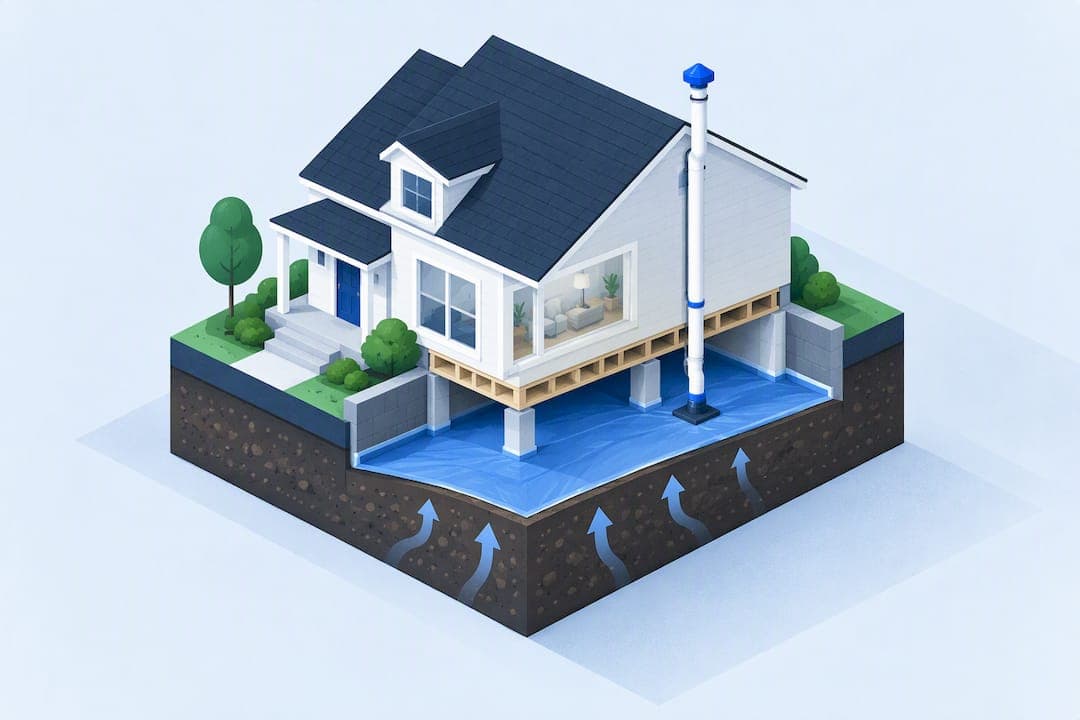
For crawl spaces, a sealed membrane paired with sub-membrane depressurization, meaning a fan-driven suction system beneath the membrane, is the most reliable way to bring radon below the EPA action level of 4.0 pCi/L. Encapsulation alone, without active suction, often fails to lower radon reliably. Every installation needs a post-installation verification test to confirm it actually worked.
TL;DR:
- Sub-membrane depressurization with a sealed membrane and active fan is the most reliable method to reduce radon in crawl spaces below the EPA action level.
- Proper installation requires sealing seams, penetrations, and ensuring the membrane is thick enough to withstand soil and foot traffic for long-term durability.
- Testing before and after installation, along with monitoring the system's manometer, confirms radon levels are reduced and the fan is functioning correctly.
- Passive venting or sealing alone rarely achieves the necessary radon reduction, making active systems essential for consistent results.
- Regional soil conditions and foundation types influence system design; site-specific planning and verification are critical for effective mitigation.
Table of Contents
- How sub-membrane depressurization captures radon beneath the crawl space
- Materials and a homeowner-ready installation checklist
- Alternatives, tradeoffs and when they may be appropriate
- Designing, testing and verifying a successful system
- Common mistakes, failure modes, and quick homeowner checks
- Costs, typical timeline, and when to hire a certified mitigator
- Standards, safety requirements and installer best practices
- Signs that radon levels are unsafe before testing
- Health risks associated specifically with crawl space radon exposure
- Maintenance requirements for installed mitigation systems
- Regional factors influencing crawl space radon levels
- Author perspective: why tailored systems and verification testing matter
- How Cincinnati Radon Solutions can help
- FAQ
- Sources
How sub-membrane depressurization captures radon beneath the crawl space
Sub-membrane depressurization, often shortened to SMD, works by creating a vacuum under a sealed plastic sheet so radon gets pulled out before it ever reaches your living space. The system has a few core parts working together:
- A high-density membrane laid over the entire crawl space floor and sealed at every edge and seam.
- A perforated pipe network or collection point positioned beneath the membrane to gather soil gas.
- A vent pipe routed through the foundation and up to roof height, away from windows and doors.
- An in-line fan, mounted outside living space, that pulls air through the system continuously.
Once the fan runs, it creates negative pressure under the membrane, which intercepts radon-laden soil gas before it migrates upward. The EPA's consumer guide recommends this approach specifically for crawl spaces, noting that membranes should overlap seams and be sealed to foundation walls to form a collectable plenum underneath. Sizing matters too: larger crawl spaces, partitioned areas, or spaces with multiple piers often need more than one suction point to avoid dead zones where the vacuum never reaches.
Materials and a homeowner-ready installation checklist
The membrane itself needs to survive foot traffic, settling soil, and years of continuous suction without tearing. Most durable installations use a high-density polyethylene sheet rated at a minimum thickness measured in mils, thick enough to resist punctures from gravel, rocks, or pier edges.
A solid installation typically follows this sequence:
- The crew clears debris and levels the crawl space floor before laying membrane.
- Membrane sheets are overlapped at seams, usually by a foot or more, then sealed with tape or a polyurethane caulk suited for below-grade conditions.
- Pipes, piers, and support columns get individually sealed with boots or collars so no gap allows soil gas to bypass the barrier.
- The perforated collection pipe is placed under the membrane before final sealing, then it is connected to the vertical riser.
- The membrane is anchored at the perimeter with mechanical fasteners or battens, leaving enough slack so it can conform to the soil when suction pulls it down.
Pro Tip: Ask your installer to show you the seam overlap and penetration seals before the membrane is fully covered. Once the fan is running, these details are impossible to check without cutting into the barrier.
Alternatives, tradeoffs and when they may be appropriate
Passive ventilation, simply venting the crawl space to outside air, rarely gets radon below the action level on its own because it depends on wind and temperature differences rather than continuous mechanical draw. Active crawl-space ventilation (CSV) is sometimes used instead of or alongside SMD when membrane installation is impractical, but it comes with real tradeoffs.
- CSV dilutes radon by exchanging air, typically aiming for one to three air exchanges per hour, according to ITRC guidance.
- That same guidance notes CSV carries energy penalties and a risk of backdrafting combustion appliances if not carefully designed.
- Sealing penetrations and cracks without any active suction or ventilation can help marginally but is rarely sufficient by itself.
For most crawl spaces, SMD remains the preferred fix specifically because it works independent of weather and outdoor air exchange.
Designing, testing and verifying a successful system
A good mitigation job starts before anyone touches a membrane. Diagnostic testing under baseline, closed-house conditions tells the installer how radon levels behave and shapes decisions about fan size and suction point count.
- Closed-house baseline testing establishes starting radon concentrations under normal living conditions.
- Diagnostic tests performed under a temporary membrane section or through test holes show how well suction will spread across the crawl space, which guides where to place suction points and how large a fan the job needs.
- After installation, a post-mitigation clearance test confirms whether radon has dropped below the action level, and practitioner mitigation guidance recommends adding suction points or repairing seals and retesting if levels remain high.
A visible manometer, a simple pressure gauge mounted on the system, lets you confirm the fan is maintaining suction day to day without waiting for another lab test.
Common mistakes, failure modes, and quick homeowner checks
Most underperforming systems share the same root causes. Practitioner guides point to incomplete membrane coverage, unsealed seams, and undersized fans as the most frequent reasons radon levels stay elevated after a supposed fix.
- Membrane that stops short of walls or piers leaves gaps where soil gas bypasses the barrier entirely.
- A fan mounted inside living space, rather than in an attic, garage, or outside, can leak radon into the house it's meant to protect.
- Tight bends or undersized piping restrict airflow and reduce the vacuum reaching distant corners of the crawl space.
Pro Tip: Check the manometer monthly, listen for the fan running, and glance at the membrane for tears or lifted edges. A silent fan or a flat gauge reading means it's time to call for service.
Costs, typical timeline, and when to hire a certified mitigator
Price depends heavily on crawl space size, access difficulty, headroom, and whether the job needs multiple suction points to cover partitioned areas. Our local cost guidance outlines how these factors typically shape a quote.
A typical project runs through three stages: an initial inspection and diagnostic testing, the installation itself, and a post-installation clearance test that confirms results. Each stage should be documented in writing before work begins.
- Ask whether the installer holds ANSI/AARST certification for mitigation work.
- Confirm the contract explicitly includes post-installation verification testing, not just the installation.
- Request a written, itemized quote rather than a verbal estimate.
Standards, safety requirements and installer best practices
ANSI/AARST mitigation standards spell out specific sealing, seam overlap, and labeling requirements for sub-membrane systems, along with provisions for fan monitoring in spaces that are hard to access later, according to RMS-MF 2018 with its addenda. Safety provisions matter just as much as sealing: a failing fan should trigger a visible or audible alarm, and systems near combustion appliances need design that avoids backdrafting risk.
Leave excess membrane slack at wall attachments so the sheet can conform to the soil and avoid being pulled off or punctured when vacuum is applied. Utah DEQ, Radon techniques for home construction
That slack detail gets skipped often, and it is one of the more common reasons membranes fail within the first year.
Signs that radon levels are unsafe before testing
Radon has no smell, no color, and no taste, which means there is no physical warning sign you can rely on before testing. That said, certain home characteristics raise your odds of an elevated reading. A crawl space foundation itself is one, since soil sits directly beneath your living floors with far less separation than a basement slab provides.
Homes built on soil with high uranium or granite content, or in regions known for elevated radon readings, carry higher baseline risk. Cracks in the foundation, gaps around plumbing penetrations, or a sump pit left uncovered in the crawl space all give soil gas easier paths upward. A musty, damp crawl space suggests moisture problems that often coincide with poor sealing, though dampness itself is not a radon indicator.
None of these signs substitute for an actual test. Radon concentrations can vary house to house even on the same street, since soil composition and foundation cracks differ at a very local scale. The only way to know your actual level is a short-term or long-term test kit, or a professional test using continuous monitoring equipment. If you have never tested a crawl space home, that is reason enough to test now rather than wait for a sign that may never come.
Health risks associated specifically with crawl space radon exposure
Radon gas decays into radioactive particles that lodge in lung tissue when inhaled, and long-term exposure is a recognized cause of lung cancer. What makes crawl space homes a particular concern is proximity: soil gas has a shorter, more direct path into the living space above than it does in homes with a full basement or thick slab separating living areas from the ground.
Crawl spaces are often connected to the rest of the house through return ducts, floor penetrations, or a stack effect that pulls air upward from the crawl space into rooms above. That means radon accumulating under an unsealed or poorly sealed crawl space does not stay contained. It moves into bedrooms, living rooms, and kitchens through the same pathways that let in whatever else is in that crawl space air.

Risk accumulates with exposure over time and concentration, not from a single reading. A level just above the action level sustained for years carries different risk than a brief spike. This is why the EPA frames 4.0 pCi/L as an action level rather than a hard safety cutoff: reducing exposure below that threshold meaningfully lowers risk, and further reduction is still worthwhile when practical. Testing and mitigation are the only tools that turn an invisible risk into a measurable, manageable one.
Maintenance requirements for installed mitigation systems
A mitigation system is not a one-time fix you install and forget. Fans wear out, typically lasting several years of continuous operation, and a failed fan means the entire system stops protecting the home even though the membrane still looks intact. This is why a visible manometer matters so much: a quick glance tells you whether suction is still active without needing a new lab test.

Periodic retesting is the other half of maintenance. A system that passed clearance testing when installed can lose effectiveness if a seam separates, a fan degrades, or settling creates new gaps in the membrane. Retesting every two years, or after any renovation that disturbs the crawl space or foundation, confirms the system is still doing its job.
Visual inspection costs nothing and catches problems early. Look for membrane that has lifted at the edges, tears near piers or pipes, or standing water pooling on top of the barrier, since pooled water can signal a seam failure letting ground moisture through. If the fan is unusually loud, silent when it should be running, or vibrating against ductwork, that is worth a service call before the next scheduled test rather than after.
Regional factors influencing crawl space radon levels
Radon originates from uranium decay in soil and rock, so geology drives most of the variation you see between regions, and even between neighboring properties. Areas with granite bedrock, certain shale formations, or glacial till deposits tend to produce higher soil gas concentrations than areas with denser clay or limestone that restricts gas movement.
Soil permeability affects not just how much radon is present but how easily a mitigation system can pull it out. Loose, sandy, or gravelly soil under a crawl space lets suction spread efficiently across a wide area from a single suction point. Dense clay soil restricts airflow more, which is part of why diagnostic testing before installation matters: it tells the installer whether the site needs multiple suction points to achieve even coverage.

Foundation type compounds these geological factors. A crawl space foundation, according to Utah DEQ's construction guidance, places soil directly beneath living floors, which increases radon entry risk compared to foundation types with thicker, more continuous slab separation. Homes with a combined foundation, part crawl space and part slab, often need a tied system or multiple mitigation solutions working together rather than treating each foundation section as a separate problem.
Author perspective: why tailored systems and verification testing matter
Crawl space radon mitigation is not a generic kit you drop into any foundation. Soil conditions, crawl space layout, and foundation type all change what a system needs to work, which is why we favor site-specific design over cookie-cutter installs. Insist on written test results before and after installation, and a warranty that spells out what happens if levels do not drop.
— Yoshua
How Cincinnati Radon Solutions can help
We design mitigation systems tailored to specific crawl spaces, and every job includes post-installation verification testing so you have documented proof it worked, not just an installer's word.

Our relevant services include:
- Radon testing to establish baseline levels before any design decisions are made.
- Custom sub-membrane depressurization design for crawl spaces, slabs, and combined foundations.
- Verification testing included after installation, with documented results.
- Repair and fan replacement for systems that are underperforming or have failed.
A written quote spells out scope, materials, and the included post-installation test before work starts, and installations follow ANSI/AARST standards. Visit our services page to request a quote for your crawl space.
This article is general information, not a substitute for advice from a qualified doctor. Consult a qualified healthcare professional about your own circumstances before acting on anything here.
FAQ
Is radon worse in a basement or crawl space?
Neither foundation type is inherently worse everywhere, since radon levels depend more on local soil and geology than on foundation type alone. Crawl spaces do place soil closer to living floors with less separation, which is part of why sub-membrane depressurization is the standard EPA-recommended fix for that foundation type specifically.
Does crawl space encapsulation reduce radon?
Encapsulation alone, meaning a sealed membrane with no active suction, is primarily a moisture control measure and often does not reliably reduce radon below the action level on its own. Pairing the membrane with fan-driven sub-membrane depressurization is what actually creates the vacuum needed to pull radon out before it enters the home.
Can radon penetrate drywall?
Radon gas can move through small cracks and gaps far more easily than through solid materials, so the bigger concern is unsealed penetrations, seams, and foundation cracks rather than drywall itself. Sealing entry points at the foundation and crawl space level addresses the actual pathway radon uses to reach living space.
What radon level requires mitigation?
The EPA sets the action level at 4.0 pCi/L, and EPA guidance recommends mitigation when a test confirms levels at or above that threshold. Reducing exposure below 4.0 pCi/L is the goal, though further reduction below that level is still worthwhile where practical.
How do I know if my mitigation system is still working?
A visible manometer on the system shows whether the fan is maintaining suction, and a sudden change in that reading, or a fan that goes silent, signals a problem. Practitioner guidance also recommends periodic retesting, roughly every two years, to confirm the system is still keeping radon below the action level.
Sources
- Consumer's Guide to Radon Reduction - How to Fix Your Home (EPA)
- Mitigation_789_PubicReview_05-2020 (AARST mitigation guidance)
- ITRC - Crawl-space ventilation and vapor intrusion guidance (2026)
- Radon mitigation crawl space: what homeowners need to know (InspectandTest)