
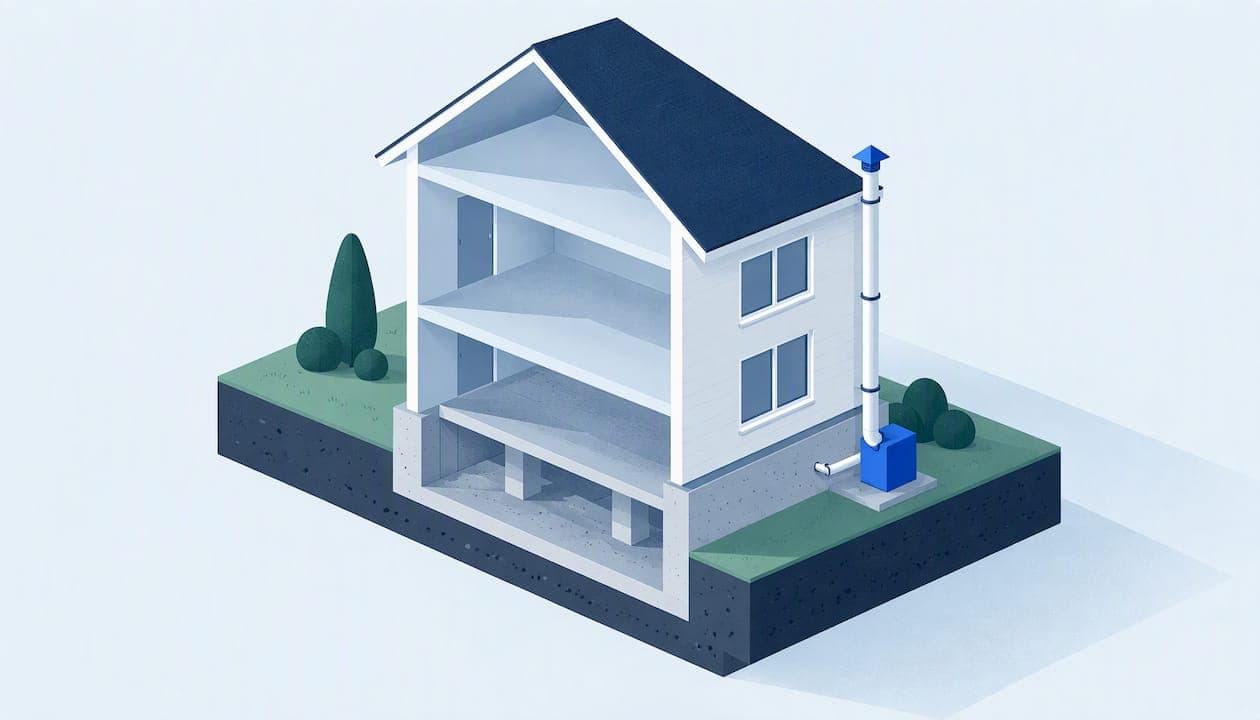
A radon fan belongs outside the conditioned part of your house: in an unoccupiable attic, in a garage that is not beneath living space, or on the exterior wall or roof. It does not belong in the basement, in a crawlspace, or anywhere below ground. ANSI/AARST standards say so plainly, and the reason is simple physics, which we explain below.
If you are standing in your basement looking at a fan humming next to the sump pit, or a contractor just proposed putting one there, this article is for you. We will cover the approved locations, how to pick among them, what to check on a system you already own, and what changes for new construction.
TL;DR
- Approved fan spots are a non-occupiable attic, a garage not under conditioned space, or the building exterior. Basements and crawlspaces are out.
- The pipe on the exhaust side of the fan is under positive pressure, so a leak inside the living envelope pushes concentrated soil gas into the house.
- Run the fan continuously. Turning it off or down can let radon rebound, sometimes above pre-mitigation levels.
- A quiet fan is not necessarily broken, but a pressure gauge showing no suction means the system is not protecting you. Call a certified mitigator.
- Building new? The standard calls for a clear space of at least 21 inches in diameter and 36 inches high around the pipe for a future fan.
Table of Contents
- Why the fan location matters at all
- Approved radon fan locations
- Why the basement is the wrong place
- Where radon is highest in the house (and where to test)
- How the Cincinnati area changes the picture
- Picking the right spot for your home
- Rough-ins and new construction
- Keep the fan running, and know what to watch
- Our perspective
- Getting help in Greater Cincinnati
- FAQ
- Sources
Why the fan location matters at all
A standard active system is called sub-slab depressurization. A pipe goes into the soil or gravel under your slab, and a fan pulls radon-laden air from beneath the foundation and vents it outdoors, as EPA's physician guide describes it. The fan creates suction on the pipe below it and pressure on the pipe above it.
That second half is what drives the location rules. The exhaust side of the fan is under positive pressure. According to EPA's radon mitigation standards, any leak in that pipe inside the home's conditioned envelope could release concentrated soil gas, radon included, straight into the living space. The air in that pipe is not the air in your basement. It is soil gas, and it can carry far more radon than a room does.
So the goal is not to hide the fan. The goal is to make sure that any pressurized pipe, and the fan itself, sit where a leak would vent to the outside rather than into a bedroom.
Approved radon fan locations
The AARST standard for new construction lists the acceptable places for active soil depressurization fans: unoccupiable attics, garages not beneath conditioned spaces, or the exterior of the building. The same logic applies to retrofits in existing homes.
| Location | Acceptable? | What to know |
|---|---|---|
| Unoccupiable attic | Yes | Common and quiet. Needs safe access for service, and the pipe must exit above the roofline. |
| Garage not beneath living space | Yes | Easy access. A bedroom or bonus room above the garage changes the answer. |
| Exterior wall or roof | Yes | Outside the envelope entirely. Needs weather-rated wiring and a sensible look. |
| Basement | No | Inside the conditioned envelope. Any joint leak vents into the home. |
| Crawlspace | No | Same problem, and often damp and hard to service. |
| Anywhere below ground | No | Excluded by the standard. |
| Attic over finished living space | Depends | Fine if the attic is unoccupiable and no vent pipe leak path leads to the rooms. Your mitigator should check. |
The attic
Attics are the most popular choice in houses where the pipe can run up through a closet or interior chase. The fan sits in the attic space, and the pipe continues through the roof. Because the fan is out of the living area, a leak around it exhausts into the attic and then outdoors.
Two things to watch. First, an attic used for storage or finished as a room is occupiable, and that changes things. Second, the pipe still passes through the living space between the slab and the attic, so every joint on that run must be sealed properly. That is installation quality, not location, and it is why we pressure and smoke check connections.
The EPA's handbook on sub-slab depressurization also notes that when using a quiet in-line centrifugal fan in an attic, you should try to locate it near a central point in the piping. That is a design detail a good installer weighs against access and noise.
The garage
Garage placement works when the garage is not under a conditioned room. Attached garages in many Cincinnati-area homes sit beside the basement wall or slab, which makes the pipe run short. If there is a room above the garage, the fan should go elsewhere.
The exterior
Exterior mounting is the most conservative choice and one the EPA guidance has long favored. For larger buildings, EPA guidance states that because the fan is under positive pressure and might leak, it should always be mounted outside the building. Homes are not schools, but the reasoning carries over.
Outdoor fans bring their own practical details. Per the same EPA mitigation standards, professional installers hard-wire exterior fans rather than using plugs, which degrade in UV and moisture, and add a disconnect switch within sight of the fan so it can be shut off safely during service.
Why the basement is the wrong place
The basement is tempting. It is close to the slab, the pipe run is short, and the fan is hidden behind a utility area. It is also the location the standards specifically rule out.
Here is the scenario. Your basement tests at 8 pCi/L. The fan pulls soil gas through the pipe and pushes it out. The air inside that exhaust pipe can carry radon at a much higher concentration than your room. If a glued joint, a crack in the fan housing or a loose coupling leaks, the leak is on the pressurized side. Nothing pulls it back down. It goes into your living space, and because radon is odorless and colorless, you would not know until a later test.

A fan in the basement can look like it works, and it may even pass an initial test. The risk is the failure that comes later, silently. That is why the standards treat it as a location problem and not an installer preference.
If you already have a basement fan, you do not have to panic, but you should have it evaluated. Moving a fan is usually a modest job compared with the risk it removes. Our radon system repair and fan replacement service covers evaluating the existing setup and relocating the fan to an approved spot.
Where radon is highest in the house (and where to test)
People often confuse fan location with where the radon is. They are different questions.
Radon concentrations are generally highest in the lowest lived-in level of the home, such as a basement or ground floor, because those areas have the most direct contact with the soil, according to EPA's physician guide. The same guide says test kits belong in those lower levels, about 20 inches off the floor, away from drafts, humidity and high-airflow areas such as kitchens and bathrooms, and tests must run at least 48 hours.
A few practical points:
- Test in the lowest room you actually use, not an unused crawlspace.
- Keep windows and exterior doors closed as much as normal during the test.
- Do not rely on a neighbor's result. Houses next door to each other can differ widely.
If you want to know how long a test should run and why a longer one can be more reliable, we wrote about it in radon test duration for homeowners. And if you are reading a result near the action level, our guide on confirming results at 4 pCi/L walks through the next step.
How the Cincinnati area changes the picture
Greater Cincinnati sits on geology that favors radon. According to Ohio Department of Health data compiled on radoninohio.com, Hamilton County is in EPA Radon Zone 1 and has an average indoor level of 3.22 pCi/L across 43,610 tests, with a maximum recorded of 316.65 pCi/L. An average below 4 does not mean your house is below 4. The same page notes that homes next door to each other can differ greatly.
That variation is why we design from your foundation and not from a template. A poured basement slab, a fieldstone wall, a dirt-floored crawlspace and a slab-on-grade addition each create different suction needs and different places where the pipe can go. You can check area numbers on our Ohio radon levels by ZIP code page, then confirm with a test in your own house.
Picking the right spot for your home
When we walk a house, the fan location comes out of a few questions.
- Where can the pipe run with the fewest bends and the least length inside living space? Shorter, straighter runs mean fewer joints that can leak.
- Is there an unoccupiable attic above the route? If yes, attic placement is often clean and quiet.
- Is there a garage that is not under a room? If yes, it can be the simplest, most accessible choice.
- Is exterior mounting a better fit? Often yes for finished attics, living space over a garage, or homes with no practical interior route.
- Can someone reach it later? A fan that cannot be serviced will be a problem the day it fails.
- Where does the pipe discharge? The EPA standards address preventing re-entrainment at the point of discharge, meaning the exhaust should not blow back toward windows, doors or air intakes.
Sound matters too. A fan on an exterior wall under a bedroom window can be heard on a still night. A fan in an attic above the same room usually cannot. Neither is wrong, but you should hear the tradeoff before the install, not after.
Rough-ins and new construction
If you are building, you have a big advantage. A passive rough-in costs little when walls are open and can be activated by adding a fan later if testing calls for it. The AARST new-construction standard requires clearance for the future fan: a cylindrical space at least 21 inches in diameter and 36 inches high, centered on the pipe, so the fan can be installed and later replaced.
Builders sometimes frame that space out or run the pipe into a spot where no fan can ever fit. Then the "simple activation" turns into a remodel. If you are a builder or a buyer of a new home, plan the fan location on the drawings, usually in the attic or on the exterior. We also explain why even a brand-new house deserves a test in radon in new homes.
A home with a passive system is not necessarily protected. The EPA's Building America guidance describes the active vent system with in-line fan as the version that pulls the soil gas. If a passive stack was roughed in and the levels have since risen, the next step is to test and then add the fan in an approved location.

Keep the fan running, and know what to watch
A mitigation fan works only while it runs. EPA guidance says that turning the fan off or lowering the power can let radon levels rebound, often to levels above those measured before mitigation. It also recommends verification testing at least 24 hours after the fan is turned on, so the pressure field has stabilized. Older EPA technical guidance says that when the house is occupied you should not turn the fan off or down from the setting the mitigator chose.
So do not unplug it to save a few dollars of electricity or to stop a noise. Call us about the noise.
A simple routine
- Look at the pressure gauge (manometer) on the pipe now and then. Note its normal reading.
- Listen for a change in the fan sound, such as rattling or grinding.
- Check that the disconnect switch is on and that exterior wiring is intact.
- Retest at least every two years, and after renovations, foundation work or a fan replacement.
A silent fan is not automatically a dead fan, since many modern fans are very quiet. But if the gauge shows the suction is gone, the system is no longer protecting the home and needs professional repair right away. Our radon system maintenance checklist and the guide on what to check when mitigation seems not to work cover the details.
Monitoring a fan has something in common with other fuel-burning and ventilation systems in your home. Homeowners who watch their radon gauge may also want to read up on furnace carbon monoxide risks and the tests they can request, because both hazards are invisible and both depend on equipment doing its job quietly.
Our perspective
We do one thing: radon testing and mitigation. That focus changes how we think about fan location.
Most fan problems we see are not exotic. They are convenience decisions. A fan went in the basement because the pipe was short, or the attic route was hard, or someone wanted the system out of sight. The homeowner got a system that seemed to work and a risk nobody explained.
We design each system around the specific foundation and specific house, then pick the fan location from the approved list. If the easy route is the unsafe one, we take the harder route. Every mitigation we install includes verification testing afterward, and our installations are ANSI/AARST certified. We give fixed written quotes, with no added costs after quoting, so the location conversation happens on paper before work starts.
If we inherit a system with a basement fan, we say so, show you why, and give you the options. The decision is yours, but you should make it with the facts.
— Yoshua
Getting help in Greater Cincinnati
If you are not sure where your fan is, or whether the location is acceptable, start with an assessment. We can test the house, review an existing system, or design a new one. For a sense of how pricing works, see our radon mitigation cost guide, and learn more about radon mitigation systems or book radon testing in Cincinnati. Realtors and sellers can ask us for documentation suitable for a real estate transaction. If you want to compare approaches first, our overview of radon mitigation methods explains how each system fits different foundations, and the piece on radon in old homes covers fieldstone and dirt floors.
FAQ
Where is the best place to put a radon fan?
The best place is outside the conditioned space: an unoccupiable attic, a garage not beneath living areas, or the building exterior. Which of these is best for your house depends on where the pipe can run with the fewest joints and where the fan can be reached for service. A certified mitigator should choose it after looking at your foundation.
Can radon fans be located in the basement?
No. ANSI/AARST standards do not allow fans in basements, crawlspaces or any interior location directly beneath conditioned or occupiable space. The exhaust side is under positive pressure, so a leak would push soil gas into the home. If your fan is in the basement, have a certified professional evaluate moving it.
Should I leave my radon fan on all the time?
Yes. The fan only reduces radon while it is running, and EPA guidance warns that turning it off or down can cause levels to rebound. If it is noisy or the gauge reading has changed, call a mitigator instead of switching it off.
Where in the house is radon highest?
Usually in the lowest lived-in level, such as the basement or first floor, because it touches the soil most directly. EPA's physician guide says to test there. Levels can vary from house to house, so only a test in your own home tells you.
Sources
- ANSI/AARST RRNC 2020, Section 701: provision for ASD system fan
- EPA Radon Mitigation Standards
- EPA Radon Mitigation Standards (discharge and re-entrainment)
- EPA: Radon Prevention in the Design and Construction of Schools and Other Large Buildings
- EPA: Radon Reduction Techniques for Existing Detached Houses
- EPA: Sub-Slab Depressurization for Low-Permeability Fill Material handbook
- EPA: A Physician's Guide to Radon
- Building America Solution Center: Radon Fan
- Furnace Carbon Monoxide Risk: 4 Signs and Tests