
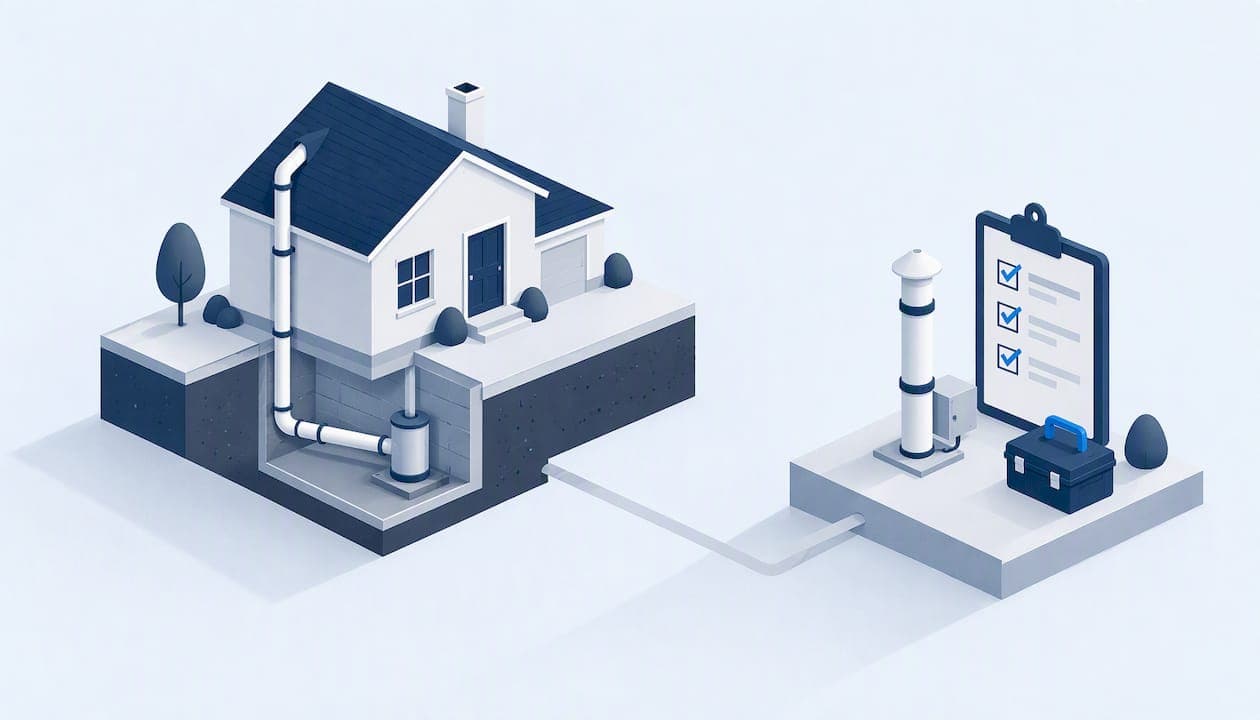
A radon mitigation system needs very little upkeep, but it does need some. Read the gauge on the pipe every month or so, listen to the fan, and retest your home at least every two years. The EPA compares the upkeep to that of a furnace or chimney: occasional, not constant. The fan is the one part that wears out, and it is usually a quick swap.
This guide covers what to look at, what a failing system sounds and looks like, what a fan replacement costs, and when a retest matters more than any gauge.
TL;DR
- Your radon fan must run 24/7. Turning it off lets radon return to pre-mitigation levels, often within hours.
- Check the manometer (the U-shaped gauge on the pipe) regularly. If the liquid is level on both sides, the fan is not pulling suction.
- Retest at least every two years, and after any renovation or HVAC change, even if the fan sounds fine.
- Fans often last five years or more. A replacement typically runs $200 to $350 including parts and labor.
- A gauge is only a performance indicator. Only a radon test proves the house is protected.
Table of Contents
- Why a radon system is not "set it and forget it"
- The monthly check: read the manometer
- Listen, look and feel
- Winter and weather: why Cincinnati homes see cold-snap problems
- Retest at least every two years
- Fan lifespan and replacement cost
- Signs your radon system needs service
- What you should not do
- Our perspective: why upkeep begins at installation
- When to call a professional
- Need service on an existing system?
- FAQ
- Sources
Why a radon system is not "set it and forget it"
Most systems are active soil depressurization (ASD) systems. A pipe runs from beneath the slab, or from under a crawl space membrane, up and out above the roof. An in-line fan pulls radon-laden soil gas through that pipe and vents it outside before it can seep into the living space. EPA and AARST guidance says that fan must run continuously to keep the suction going.
Radon has no smell, color or early symptoms, as the CDC's ATSDR radon pages note. So you cannot tell by living in the house whether the system is still doing its job. A fan can die on a Tuesday and nothing in your day will change. That is why a few routine checks matter more than they seem to.
The stakes are real. The EPA action level is 4 pCi/L, and about 6 million US homes exceed it. The same source notes that risk exists below that level too. Your system exists to keep your family well under that line, so keeping it running is part of the investment you already made.

The monthly check: read the manometer
Look at the pipe near the fan or in the basement, where the installer should have put a warning device. On most homes it is a U-tube manometer: a clear U-shaped tube with colored liquid and a scale.
- Find the gauge. It is usually on the vertical pipe, at about eye level, in the basement, garage or utility area.
- Read the two columns. If the liquid is at different heights, the fan is creating suction. Many installers mark the normal reading when the system is commissioned, so photograph it.
- Compare to your baseline. If the levels are even, the fan is not providing suction.
- Note any change. A reading that has drifted well from your photo can mean a clogged pipe, a failing fan or a new air leak.
The EPA says to look at your warning device regularly, and it suggests learning to read it yourself instead of waiting for a professional visit. Put a recurring reminder on your phone, the way you would for a smoke detector battery or a furnace filter. If you like a fixed schedule for home systems, this overview of how maintenance schedules work shows the same habit applied to heating and cooling.
One caution: the manometer is not a radon detector. It is a mechanical indicator of suction. A level gauge means trouble. An unequal gauge is a good sign, but not proof of low radon.
Listen, look and feel
The gauge is one check. Spend two minutes on the rest.
- Fan sound. Know what your fan sounds like. A new grinding, humming, rattling or a sudden silence deserves attention. Silence with no gauge reading means the fan has probably stopped.
- Vibration. A pipe that buzzes or knocks may have a loose strap or a fan with a worn bearing.
- Visible pipe. Look for cracks, loose joints, disconnected sections or crushed pipe in the basement, garage or attic.
- Seals. Check the caulk or sealant where the pipe meets the slab, and around sump pits, floor cracks and utility penetrations. Gaps let room air reach the suction zone and weaken performance. If a bead has cracked or pulled away, resealing is a modest job, and this guide on caulk lifespan explains why sealant ages and needs a periodic look.
- Exhaust point. Make sure the discharge above the roof is not blocked by debris, a nest or ice.
- Power. Confirm the fan's switch or breaker has not been flipped off. A tripped breaker is a common reason for a dead system.
If you want a structured walkthrough when something seems off, our post on eight checks to run before calling for service covers them in order.
Winter and weather: why Cincinnati homes see cold-snap problems
Systems with fans in attics or exposed exterior runs can be affected by weather. In cooler climates, condensation can form in the pipes and, if the pipe lacks proper drainage, can restrict airflow. A rattling sound or a change in the gauge during a cold snap is the typical sign.
If you see that pattern, do not keep resetting the fan or tapping the pipe. Photograph the gauge, note the temperature, and have a certified professional look at pipe slope and drainage. It is usually a fix to the routing, not a new system.
Retest at least every two years
This is the single most useful maintenance habit. The EPA recommends retesting at least every two years, and also after major structural or HVAC changes. Experts who work with certified providers stress that visual indicators alone are not proof. The follow-up test is.
Some homeowners get a letter asking for a service visit every two years and wonder whether it is a sales pitch. The honest answer: the visit is not a fix for a problem, it is a measurement. If your gauge shows suction, the retest is what confirms the number. You can do it with a kit or book a professional radon test. If a result looks odd, see our note on confirming test results at 4 pCi/L before you act.
When to retest sooner
- You finished a basement or added a room.
- You replaced or modified the furnace, ductwork or air handling.
- You replaced the fan or repaired the pipe.
- Your gauge reading changed and stayed changed.
- You are selling and a buyer wants current documentation.
Renovations and HVAC changes can disrupt the soil depressurization that keeps radon out, even when the fan runs perfectly.
Fan lifespan and replacement cost
The fan is the only moving part. Fans may last five years or more, and manufacturer warranties generally do not exceed five years. The same EPA page puts a replacement at roughly $200 to $350 for parts and labor. Prices vary by fan model, access (attic, garage or exterior) and whether piping needs work. Packages that bundle a longer warranty can cost more.
The EPA page lists these figures as typical, not as a quote for your house. Ask any provider for a fixed written price before work starts, and ask what the quote covers: the fan, the labor, a gauge check and a post-repair retest.
| Item | What to expect |
|---|---|
| Gauge check | Free, monthly, yourself |
| Short-term test kit | Do-it-yourself or professional test, at least every two years |
| Fan replacement | Typically $200 to $350 including parts and labor, per the EPA |
| Fan lifespan | Five years or more |
| Electricity | Continuous, small, ongoing |
Signs your radon system needs service
| Sign | Likely cause | What to do |
|---|---|---|
| Gauge liquid is level | Fan off, failed or blocked pipe | Check breaker, then call a certified pro |
| Fan is silent | Power loss or dead motor | Check power; schedule fan replacement |
| Loud rattling or humming | Worn bearing, loose mount, condensation | Do not ignore; book service |
| Rattling in a cold snap | Condensation or ice in the pipe | Have drainage and routing inspected |
| Retest above 4 pCi/L | System no longer performing, new leaks, building changes | Service visit, then verify with a new test |
| Recent remodel | Changed airflow or new slab openings | Retest, then adjust if needed |
If a number comes back above 4 pCi/L, the question is why, not whether. Many causes are small: a cracked seal, a failed fan or a pipe that has been disconnected. Some are structural, like a new opening or a changed foundation condition.
What you should not do
- Do not switch the fan off to save power or silence it. Radon can return to pre-mitigation levels within hours. If the noise bothers you, ask about options.
- Do not wire or open electrical components yourself unless you are qualified. Fans are electrical equipment on a continuous circuit.
- Do not seal the pipe or vent for any reason, including to stop a draft.
- Do not trust the gauge as a final answer. It shows suction, not radon concentration.
- Do not skip the retest after repairs. A repair is not finished until a test shows the house is protected.
Our perspective: why upkeep begins at installation
We install and repair radon systems in the Greater Cincinnati area, and radon mitigation is our only focus. After years of looking at systems built by many different contractors, here is what we think.
Most maintenance trouble starts with the design, not the fan. A system tailored to the foundation, whether slab, basement, crawl space or a mix, needs less attention later because suction reaches where it should. That is why every job we do starts with site-specific measurement and ends with verification testing, so the number on the day of installation is documented and not assumed.

We also think owners should be able to read their own system. Ask your installer to show you the gauge, tell you the normal reading and write it down. If a company will not explain how the system works, that is a red flag.
And we think the two-year retest should be routine, like a smoke detector battery, not a scare. If you are in a home sale, current documentation helps both sides. Our radon contingency clause guide explains how the 4 pCi/L line plays out for buyers and sellers.
— Yoshua
When to call a professional
Call a certified radon professional when:
- the gauge is level and the breaker is on,
- the fan is silent or noisy,
- you see cracked or disconnected pipe,
- a retest is above 4 pCi/L,
- you have renovated and are unsure how it affects the system,
- you bought a home with an older system and no records.
The EPA also has guidance on finding a qualified radon service provider, including proficiency programs such as NRPP and NRSB. Ask about certification, a written quote, and whether post-repair testing is included. Installation to the ANSI/AARST standard matters too: the SGM-SF standard is the document that covers mitigation system practices for single-family homes.
Need service on an existing system?
If your fan has stopped, your gauge looks wrong or you want a system checked after a remodel, our radon system repair and fan replacement service covers it. We work from fixed written quotes, with no added costs after quoting, and we verify with testing afterward. If your home has no system yet, see our radon mitigation systems or the cost guide. Crawl space homes can read how we approach them.
FAQ
Does a radon system need maintenance?
Yes, but not much. Check the gauge regularly, listen to the fan, and retest at least every two years. The fan is the part most likely to need replacing.
How much does it cost to service a radon mitigation system?
The EPA's typical figure for a fan replacement is $200 to $350 including parts and labor. A retest adds a test kit or professional test fee. Ask for a fixed written quote so the final price matches.
What is the average lifespan of a radon mitigation system?
The pipe and sealing can last for many years if undisturbed. The fan is the wear item and often lasts five years or more, according to the EPA. Warranties usually do not go beyond five years.
My radon fan is not working. What should I check first?
Check the breaker and the fan switch, then look at the gauge. If the liquid is level or the fan is silent, call a certified professional. Do not leave the house without a working system for long, since radon can return within hours.
Is it safe to live in a house with radon?
The EPA action level is 4 pCi/L, and risk exists below it, so the goal is the lowest practical level. A working system lowers exposure, and a test confirms it. If your result is high, talk to a certified radon professional about the next step.
Sources
- How do I know if my radon mitigation system is working properly? (US EPA)
- How can you find a qualified radon service provider in your area? (US EPA)
- Radon Toxicity: Standards and Regulations (ATSDR)
- Living in a Home with a Radon Reduction System (South Carolina DES)
- ANSI/AARST SGM-SF 2017 with 12/20 revisions