
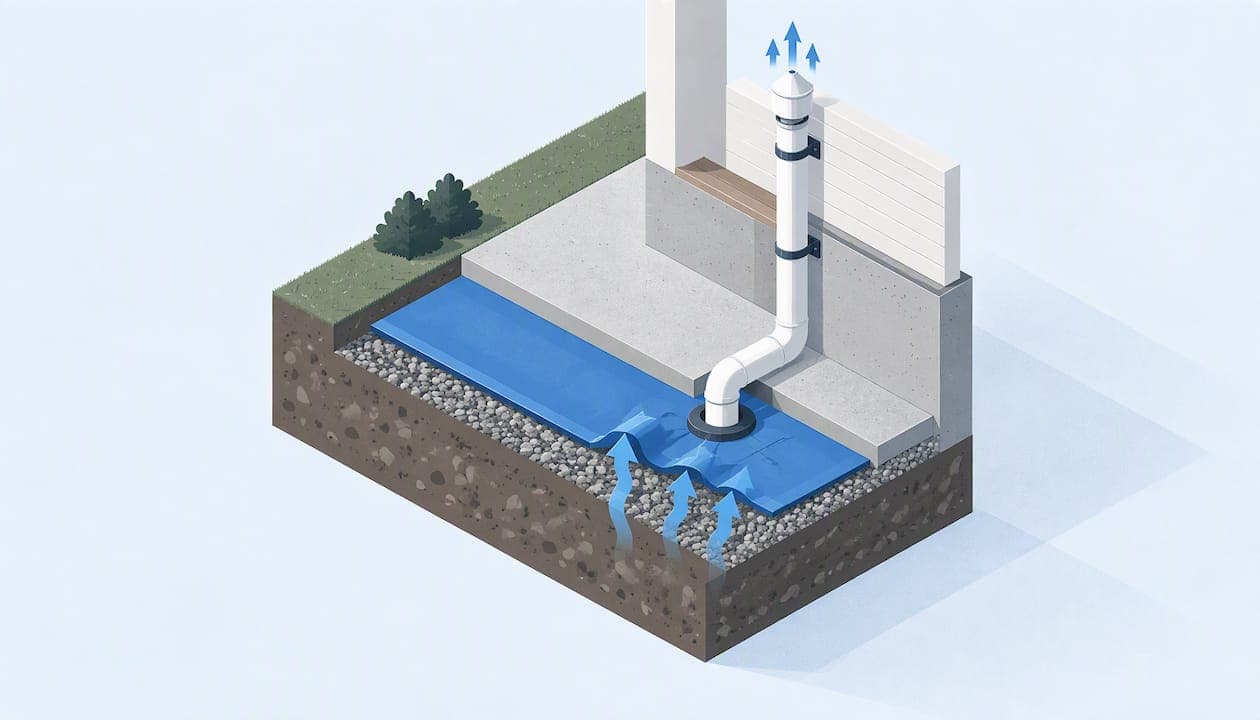
A vapor barrier is not a radon fix by itself. A plastic sheet over a crawl space floor or under a slab can help, but it only works against radon when it is sealed tight and paired with a vent pipe and fan that pull soil gas out from beneath it. That combination is called sub-membrane depressurization, and it is what the EPA describes as the most effective approach for crawl space homes.
This guide explains why, how to judge a membrane, what a proper installation includes, and how to confirm it worked. We are a Cincinnati radon contractor, so we also cover what that means for homes in the Greater Cincinnati area.
TL;DR
- A vapor barrier alone rarely brings radon down. Radon moves mainly by pressure difference, and a sheet does not change that pressure.
- The proven setup is a sealed, heavy-duty membrane plus a pipe and fan under it (sub-membrane depressurization). Sealing alone is never recommended as a stand-alone fix.
- Judge a membrane by its ASTM E1745 class and seam quality, not by mil thickness alone.
- Test first, and test again after installation. Only a verification test tells you the system works.
- Building new? Radon-resistant rough-ins cost far less than retrofitting later.
Table of Contents
- Why a plastic sheet does not stop radon on its own
- What a vapor barrier does well
- Sub-membrane depressurization: the setup that works
- Vapor barrier under a slab or in a basement
- How to judge a membrane: class, not just mil
- Vapor barrier versus radon mitigation: a quick comparison
- Test before you decide, and again after
- Perspective: what we see in Cincinnati crawl spaces
- If you are buying or selling
- Building new: put the rough-in in before the concrete
- What mitigation costs
- Work with a radon specialist
- FAQ
- Sources
Why a plastic sheet does not stop radon on its own
Radon is a gas produced by the breakdown of uranium in soil and rock. Air pressure inside a house is usually lower than the pressure in the soil around the foundation, so, in the EPA's words, your house acts like a vacuum and draws radon in through cracks and openings.
Research on prevention and mitigation points to the same mechanism: the dominant transport route is pressure-driven airflow from the soil into the occupied space, with diffusion playing a smaller role. That matters for membranes. A sheet slows diffusion and moisture, but it does not remove the pressure difference that pulls gas toward your living space.
There is a second problem. A membrane is only as good as its seams and penetrations, and perfect airtightness is hard to achieve in a real crawl space with piers, pipes, uneven soil and tight access. If gas collects under a sheet with nowhere to go, it will find the gaps. That is why a barrier without an exhaust path can disappoint.

What a vapor barrier does well
None of this makes the membrane useless. It plays three real roles:
- It gives the fan something to work on. Covering the soil creates a sealed zone under the sheet, so the fan pulls from a defined space instead of the whole crawl space.
- It cuts moisture. Soil gas retarder membranes impede movement of moisture vapor as well as soil gases, which is why crawl space encapsulation and radon work often happen together.
- It reduces the area you have to depressurize. Less open soil means a smaller leak path for the fan to manage.
Think of the barrier as one component of a system, not the system.
Sub-membrane depressurization: the setup that works
For homes with a crawl space, the EPA guidance describes the method this way: install a heavy-duty, low-permeance membrane over the entire exposed soil floor, seal all seams and penetrations, then use a vent pipe and fan to draw soil gas from beneath the membrane and exhaust it outdoors. The same source says sealing alone is never recommended as a stand-alone solution.
In practice, the steps look like this:
- Prepare the floor. Clear debris, sharp rocks and old material that could puncture the sheet.
- Lay the membrane across all exposed soil. It runs up the foundation walls and around piers.
- Seal seams, walls and penetrations. Overlaps, pipes, posts and wall edges are the usual failure points.
- Connect a suction point. A fitting through the membrane connects to a vent pipe.
- Run the pipe to a fan and exhaust above the roofline or a safe discharge point. The fan creates continuous suction under the sheet.
- Verify. A post-installation radon test confirms the result.
We go deeper on this in our article on crawl space radon mitigation and verified results, and our overview of how each radon mitigation method works shows how crawl space systems compare with basement and slab systems.
Vapor barrier under a slab or in a basement
The question comes up for slabs too. Many homes have a plastic layer under the concrete. If it was installed as moisture protection, it is rarely detailed as a radon barrier: seams are lapped rather than sealed, and nobody connected a pipe to the gravel below. Slabs also crack, and openings at the edges and utility penetrations let soil gas through regardless.
For basements and slab-on-grade homes, the usual answer is active soil depressurization: a suction point through the slab, a pipe and a fan. The design should follow the foundation. EPA guidance stresses that the system must be tailored to the home's specific foundation, whether basement, slab or crawl space. Our write-up on foundation tests that drive radon system design explains how we decide where to place suction points.
How to judge a membrane: class, not just mil
Most product pages lead with thickness: 6 mil, 12 mil, 20 mil. Thickness is a rough shorthand, not a performance measure. According to the AARST Radon Reporter, the benchmark is ASTM E1745, which classifies barriers as Class A, B or C based on puncture resistance, tensile strength and water vapor permeance (a maximum of 0.1 perms). The same article cautions against relying on mil thickness alone.
A 6-mil sheet may meet a code minimum in some settings, but a membrane that sees foot traffic, plumbing repairs and years of soil contact needs to hold up better than that. When you compare quotes, ask:
| Question | Why it matters |
|---|---|
| Which ASTM E1745 class is the membrane? | Confirms puncture, tensile and permeance performance, not just thickness |
| How are seams overlapped and sealed? | Seams are where most leaks start |
| How is it sealed at walls and piers? | Wall edges and piers are the common gaps |
| Is there a suction point and a fan? | Without one, gas has no path out |
| Where does the pipe exhaust? | Discharge should be away from windows and living spaces |
| Will the contractor run a post-installation test? | The only proof the system works |
If a quote lists only a roll of plastic and a square footage, that is a moisture job, not a radon job.
Vapor barrier versus radon mitigation: a quick comparison
| Vapor barrier alone | Sealed membrane with fan (SMD) | |
|---|---|---|
| Main job | Moisture and some soil gas resistance | Actively removes soil gas |
| Handles pressure difference | No | Yes |
| Depends on perfect seams | Heavily | Less, because suction keeps gas moving to the pipe |
| Recommended as stand-alone radon fix | No | Yes, for crawl spaces, with testing |
| Needs verification test | Yes | Yes |
If you already have an encapsulated crawl space and your radon test still reads high, that is common. The fix is usually adding the suction point and fan, not replacing the membrane.
Test before you decide, and again after
Do not buy a membrane or a mitigation system on a hunch. Test first. The EPA protocol says that if an initial short-term test, taken in the lowest lived-in level under closed-building conditions, comes back at 4 pCi/L or higher, a follow-up test is recommended before mitigation. At 10 pCi/L or above, a second short-term test gives a quick answer. Between 4 and 10, either a second short-term test or a long-term test of more than 90 days can confirm the need.

Our guide to what to do at 4 pCi/L walks through the decision. If you need a test, see our radon testing service.
After any system goes in, verification testing is essential. The same protocol document treats post-mitigation testing as the way to confirm effectiveness. A contractor who skips it is asking you to take the result on faith.
A note on low readings: the EPA has discussed that many radon-related deaths come from long-term exposure at levels below 4 pCi/L, and it has encouraged people to consider fixing homes between 2 and 4 pCi/L. If your reading sits in that range, talk to a certified mitigation professional about whether to act.
Perspective: what we see in Cincinnati crawl spaces
We focus only on radon, so we see the aftermath of the "barrier only" approach. A homeowner pays for encapsulation, the crawl space looks clean and dry, and the test still comes back high. Nobody did anything wrong with the plastic. It was simply the wrong tool for the radon part of the job.
Our approach is to design around the foundation in front of us. That means measuring first, choosing suction points based on how the home actually breathes, and treating the membrane as the sealed lid on a system rather than the system itself. We install to ANSI/AARST standards, give a fixed written quote, and test after installation so the number on the report is the one you can hand to a buyer, an agent or a lender.
One more thing we tell every homeowner: a sheet that looks perfect today can be punctured next year by a plumber, an HVAC tech or a pest control visit. Systems that rely on suction tolerate small imperfections better than systems that rely on a flawless seal. Ask for that resilience.
— Yoshua
If you are buying or selling
Radon often surfaces during inspections, and a crawl space with a new membrane does not tell a buyer anything about radon levels. What buyers and agents want is a test result and, if the number was high, documentation that a system was installed and verified. For a sense of how this plays out at the closing table, this piece on radon and closing delays shows why early testing saves time, even though it focuses on a different state.
If you are selling, test before listing so a high number does not surprise you mid-contract. If you are buying, make radon testing part of the inspection period. Our radon during a home sale work produces documentation suitable for real estate transactions.
Building new: put the rough-in in before the concrete
If you are building, the cheapest time to deal with radon is before the slab is poured. The EPA says radon-resistant new construction features typically add about $250 to $750 to construction costs, far less than retrofitting. A rough-in is a passive system: gravel layer, sealed sheeting, a vent pipe through the house and roof. If a test after move-in is high, a fan is added to make it active.
Builders and buyers can ask us about rough-ins for new builds. Doing it right means the sheeting is detailed for radon, not just for moisture.
What mitigation costs
The EPA's physician guide reports that mitigation systems typically run from $750 to $2,500, averaging about $1,200, depending on home characteristics, foundation type and local labor. That is a national figure, not our quote, and crawl space work with a full membrane can differ from a simple basement system. We give fixed written quotes after assessing the home. Our Cincinnati radon mitigation cost guide explains what drives the price locally.
Work with a radon specialist
If you have a crawl space, a high test result, or an encapsulation that did not move the number, we can help. We design each system for the foundation, install to ANSI/AARST certified standards, and run verification testing so you have proof. Start with our radon mitigation systems page, or if you already have a system whose fan has failed, see radon system repair and fan replacement. If you suspect something is off with an existing system, our 8-check troubleshooting list is a good first step.
FAQ
Does a vapor barrier stop radon?
Not by itself. Radon enters mainly because of a pressure difference between soil and house, and a sheet does not change that. A sealed membrane connected to a pipe and fan does reduce radon, and EPA guidance calls that approach the most effective for crawl space homes.
Can encapsulating a crawl space reduce radon levels?
It can help when the encapsulation is built as part of a sub-membrane depressurization system. Encapsulation focused on moisture, with no suction point, often leaves radon unchanged. Test afterward either way.
What thickness of vapor barrier should I use for radon?
Look at ASTM E1745 class rather than mil alone. The class reflects puncture resistance, tensile strength and permeance, and AARST describes that standard as the benchmark. A contractor should be able to tell you the class of the product they plan to install.
Do I still need a fan if I have a sealed barrier?
For a crawl space radon problem, yes in most cases. The fan creates the suction that moves soil gas to the vent pipe instead of letting it find gaps in the seams. Sealing alone is not recommended as a stand-alone solution.
How do I know the system worked?
Run a post-installation radon test. Verification testing is the only way to confirm the system brought levels down. Keep the report, since agents and buyers will ask for it.
Sources
- Consumer's Guide to Radon Reduction, EPA
- Radon prevention and mitigation, NCBI Bookshelf
- Choosing the Right Vapor Barrier, AARST Radon Reporter, July 2023
- A Physician's Guide to Radon, EPA
- Home testing protocols, EPA archive
- EPA request document on radon action levels, December 2012
- Radon-Resistant New Construction for Home Buyers, EPA