
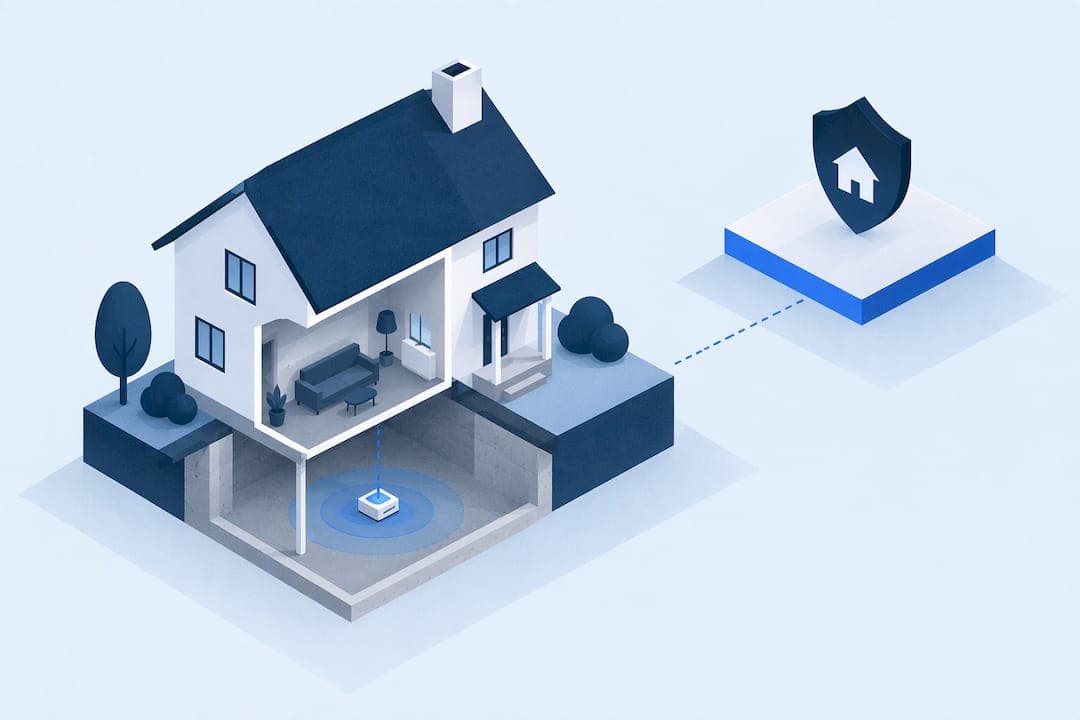
No, radon has no smell, color, or taste. Both the World Health Organization and the EPA describe it as an invisible, undetectable radioactive gas, which means testing, not sniffing, is the only reliable way to find it in your home.
TL;DR:
- Testing is the only reliable method to detect radon, as it is an odorless, invisible gas that can vary dramatically between neighboring homes.
- Radon levels above 4.0 pCi/L generally warrant a follow-up test to confirm, with mitigation through active soil depressurization being the most effective solution.
- Household odors such as sulfur, mold, or chemical smells are signs of other issues, not radon, which never causes detectable smells at any concentration.
- Short-term tests take at least 48 hours and provide a quick snapshot, while long-term tests of 90 days or more better estimate actual annual exposure.
- Air purifiers cannot remove radon gas, and mitigation systems are essential to effectively lower indoor radon levels once high readings are confirmed.
Table of Contents
- What radon is and why human senses can't detect it
- Common household smells often mistaken for radon, and their likely causes
- How to test for radon: devices, placement, and reading results
- If your test is high: mitigation overview and next steps
- A practitioner's take on testing versus trusting your nose
- If you prefer professional help with testing or mitigation
- FAQ
- Sources
What radon is and why human senses can't detect it
Radon is a radioactive gas that forms naturally when uranium and radium break down in soil and rock. The specific isotope found in homes, radon-222, has a half-life of about 3.8 days, decaying steadily into other radioactive particles long before your nose would ever have a chance to register it, because it never had a scent to register in the first place, according to the WHO.

Radon typically enters homes through cracks in foundations, gaps around pipes and sump pits, construction joints, and sometimes through well water. Because every house sits on slightly different soil and has its own foundation quirks, concentrations can vary dramatically even between two homes next door to each other. A neighbor's clean test result tells you nothing reliable about your own basement.
The EPA recommends taking action when indoor radon reaches or exceeds 4.0 pCi/L, equivalent to 150 Bq/m³. The WHO frames the risk in different terms: lung cancer risk rises by about 16% for every 100 Bq/m³ increase in long-term radon exposure. Neither agency describes radon exposure as something you would feel in the moment. There is no cough, no headache, no telltale burning sensation that shows up right away. The danger builds quietly over years of breathing contaminated air, which is exactly why testing matters more than any instinct about how your home smells or feels.
Common household smells often mistaken for radon, and their likely causes
If something in your house smells off, it is not radon. Radon carries no odor at any concentration, so an unusual smell always points to a different, often more immediate, problem.
- Rotten-egg or sulfur odor: usually a sign of a sewer gas leak or a natural gas leak, both of which warrant an immediate call to your utility provider or a plumber.
- Sulfur smell from taps: often traced to a water heater's anode rod reacting with sulfur bacteria in well water.
- Musty, damp smell: a classic sign of mold or trapped moisture, frequently found in basements and crawl spaces.
- Sharp chemical smell: commonly off-gassing from new carpet, paint, or furniture, which usually fades with ventilation.
- Burning smell: worth checking immediately, since it can indicate an electrical fault or an overheating appliance.
Pro Tip: Treat any new household odor as its own separate issue to investigate right away, and schedule a radon test regardless of whether you smell anything at all.
How to test for radon: devices, placement, and reading results
Testing comes in two main forms, and each answers a different question. Short-term tests run for a minimum of 48 hours and give you a quick snapshot, useful for real estate timelines or an initial screening. Long-term tests run for 90 days or more and estimate your home's annual average radon level, which better reflects the exposure you actually live with day to day, per EPA guidance.
Placement affects accuracy as much as duration does:
- Put the test device on the lowest level of the home you actually use regularly, not an unfinished area you rarely enter.
- Keep it away from drafts, direct sunlight, exterior doors, and windows.
- For short-term tests, maintain closed-house conditions: keep windows and exterior doors shut and avoid major heating or cooling changes during the test period.
Device choice matters too. Passive devices like charcoal canisters, alpha-track detectors, and electret ion chambers are inexpensive and widely used for both short-term and long-term testing. Active continuous monitors provide hourly readings, which helps identify unusual spikes or confirm that closed-house conditions were maintained throughout the test.
- Charcoal canisters work well for quick, short-term screening.
- Alpha-track and electret detectors suit longer monitoring periods.
- Continuous monitors offer the most detailed, tamper-resistant data.
For results you can trust, especially ahead of a home sale, professional radon testing through a state radon program or a certified tester removes the guesswork around placement and calibration that can skew a DIY kit's results.
If your test is high: mitigation overview and next steps
A result at or above the EPA's action level of 4.0 pCi/L (150 Bq/m³) calls for a follow-up test to confirm the reading before you commit to any major work, since conditions like weather and ventilation can shift results day to day, according to the EPA.
4.0 pCi/L is the threshold at which the EPA recommends taking action, and WHO data show lung cancer risk rising roughly 16% per 100 Bq/m³ of sustained exposure, which gives confirmed high readings real weight rather than reason for alarm alone.
Once a result is confirmed, mitigation is the proven path forward:
- Active soil depressurization, which draws radon from beneath the foundation and vents it safely outside, is the most common and effective method.
- Sealing major cracks and openings can supplement a mitigation system but rarely solves the problem alone.
- Improved ventilation helps marginally but does not address the source the way sub-slab systems do.
Costs vary by foundation type and home layout; a local mitigation cost guide breaks down the factors that affect pricing. Complex foundations, multi-family properties, and real estate transactions requiring documented verification testing are all situations where hiring a qualified mitigation professional makes sense rather than attempting a DIY fix.
One point worth stating clearly: ordinary air purifiers are not a substitute for mitigation. The EPA's own technical review found that air cleaners may capture some radon progeny attached to particles but do not remove the radon gas itself, so the agency does not recommend air cleaning as a way to reduce radon risk.

A practitioner's take on testing versus trusting your nose
Homeowners often ask me whether a musty basement or a strange smell means radon, and the honest answer is always no. Smell tells you nothing about radon levels. The only evidence worth trusting is a completed test, and the only confirmation that a mitigation system is actually working is verification testing done after installation.
— Yoshua
If you prefer professional help with testing or mitigation
We focus on measuring radon accurately and designing mitigation systems tailored to each home's specific foundation, not a generic template. When a confirmed high reading, an upcoming home sale, or a tricky crawl space foundation makes DIY testing feel like more risk than it is worth, we provide support from measurement through verification.

We offer comprehensive radon services including residential radon testing, verification testing after mitigation, custom-designed mitigation systems for various foundation types, and repair and fan replacement for existing systems.
If a confirmed reading or an upcoming sale has you ready to move forward, our radon testing and mitigation services page is the place to start.
FAQ
Does radon make your house smell?
No, radon produces no smell at any concentration, so a musty or unusual odor in your house points to a different problem like mold, a gas leak, or plumbing issues rather than radon. Testing remains the only way to know your home's actual radon level.
What houses are most at risk for radon?
Any home can have elevated radon, since it depends on local soil and rock geology more than home age or style, and even neighboring houses can show very different results, according to the EPA. Homes with basements or those built directly on soil tend to have more entry points, but testing is the only way to know your specific risk.
Do air purifiers clear out radon?
No, standard air purifiers do not remove radon gas from indoor air, and the EPA does not recommend air cleaning as a strategy to reduce radon risk. Mitigation systems that vent radon from beneath the foundation are the only reliable fix for a confirmed high reading.
How long do you have to be exposed to radon before it affects you?
Radon risk builds from sustained, long-term exposure rather than a single incident, with the WHO estimating lung cancer risk rises about 16% per 100 Bq/m³ increase in average indoor levels over time. There is no acute symptom or short-term exposure threshold that causes immediate, noticeable effects.
How long should a radon test run to get a reliable result?
Short-term tests should run a minimum of 48 hours and work well for quick screening, while long-term tests running 90 days or more give a more accurate picture of your annual average exposure, per EPA testing guidance. Placement on the lowest lived-in level, away from drafts and windows, matters for both test types.
Sources
- Radon and health — World Health Organization
- A citizen's guide to radon — EPA
- Residential air cleaners - a technical summary — EPA (snapshot)