
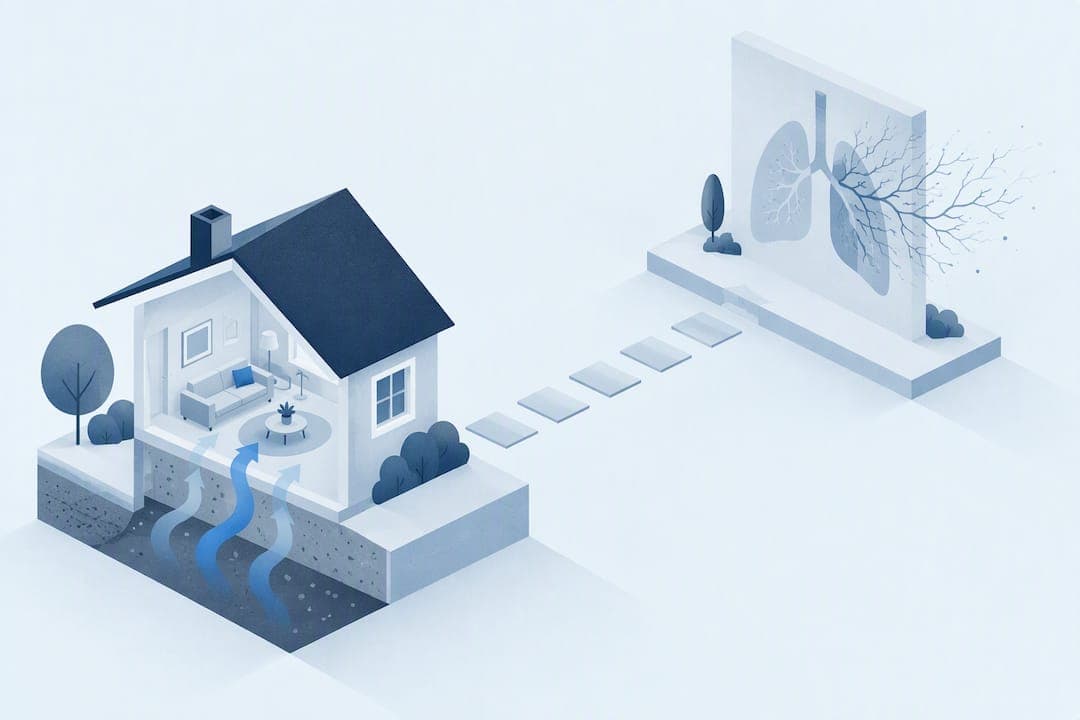
Radon itself doesn't cause immediate symptoms. Its main danger is raising your long-term risk of lung cancer, which usually produces warning signs only in later stages. If you notice a persistent cough, shortness of breath, chest pain, or coughing up blood, see a clinician promptly, and test your home for radon regardless of whether you feel unwell.
TL;DR:
- Radon related lung cancer typically develops 5 to 25 years after exposure, and no blood or urine test can detect past exposure.
- Short term tests measure radon for two to ninety days, while tests lasting more than ninety days better capture average home exposure.
- The EPA recommends mitigation at or above 4 pCi/L, although public health guidance recognizes no truly safe radon concentration.
- Smoking multiplies the harm from radon exposure rather than simply adding to it, so quitting smoking reduces a major controllable risk.
- At or above the action level, sub slab depressurization is common; choose a site specific design and verify radon levels after installation.
Table of Contents
- What symptoms show up with radon-related lung disease
- Why symptoms take years to appear
- Who faces the highest risk from radon
- How radon exposure and related disease get diagnosed
- What to do if you have symptoms or suspect exposure
- Preventing and fixing a radon problem at home
- Why measurement and verification matter more than worry
- Professional radon testing and mitigation from Cincinnati Radon Solutions
- FAQ
- Sources
What symptoms show up with radon-related lung disease
Radon doesn't announce itself. The gas is colorless, odorless, and produces no headache, nausea, or irritation the way carbon monoxide can. The trouble starts only once years of exposure have done enough cellular damage to trigger lung cancer, and by then the symptoms look identical to any other advanced lung disease.
The signs most commonly tied to advanced radon-related lung cancer include:
- A cough that persists or worsens over weeks or months
- Shortness of breath during activities that used to feel easy
- Chest pain or tightness, especially with deep breathing
- Wheezing with no clear respiratory infection
- Coughing up blood or blood-tinged mucus
- Unexplained weight loss
- Persistent fatigue
- Recurring bouts of pneumonia or bronchitis
None of these point specifically to radon. They overlap heavily with COPD, chronic bronchitis, tuberculosis, and other lung conditions, so a clinician typically needs imaging and a detailed history to sort out the cause. That ambiguity is part of why radon is such a persistent public health problem: by the time symptoms appear, the disease is usually well established. Radon-induced lung cancer is estimated to cause roughly 21,000 deaths every year in the United States, making it the second-leading cause of lung cancer after smoking.
Why symptoms take years to appear
Radon gas decays into radioactive particles that get trapped in the lining of your airways when you breathe it in. Those particles release alpha radiation directly into nearby lung tissue, and over time that radiation damages the DNA in bronchial cells. Enough accumulated damage can eventually trigger cancerous changes.

This is a slow-building process, not an acute one. Lung cancer tied to radon exposure typically develops 5 to 25 years after the exposure occurred, which means someone could be breathing elevated radon today and not see any health consequence for decades, if one develops at all.
There's also no way to test your body for past radon exposure. Clinical evaluation relies on exposure history and a respiratory exam rather than a blood or urine test, because no biomarker currently measures radon uptake after the fact. You genuinely cannot feel it happening, which is why home testing matters more than symptom watching.
Who faces the highest risk from radon
Radon risk isn't distributed evenly. A few factors substantially change how much any given level of exposure translates into actual harm.
- Smoking is the single biggest multiplier: the interaction between smoking and radon is multiplicative rather than additive, so smokers exposed to elevated radon face a far higher combined risk than either factor alone would suggest.
- Time spent in high-radon spaces matters, since radon tends to concentrate in basements and lower levels where ventilation is limited.
- Occupational exposure, older age, prior lung disease, and poor household ventilation can all add to cumulative risk.
- Foundation type and construction details influence how much radon seeps into a home from the soil beneath it.
One practical point worth remembering: radon levels can vary sharply between homes on the same street, even ones with similar foundations. A neighbor's clean test result tells you nothing reliable about your own home. Testing is the only way to know your actual number.
How radon exposure and related disease get diagnosed
Because radon produces no symptoms on its own, detection comes down to measuring the gas directly rather than waiting for a clinical sign.
- Short-term test kits measure radon over two to ninety days and give a quick snapshot, useful for an initial check.
- Long-term detectors measure over ninety days or more and better reflect the average exposure your home actually produces.
- Continuous radon monitors, typically run by a professional, give the most precise readings and can flag unusual spikes tied to weather or HVAC use.
The EPA action level is 4 pCi/L. Public health guidance treats radon as having no truly safe concentration, but 4 pCi/L is the threshold used to recommend mitigation, since risk rises with exposure level and duration.
If you do have respiratory symptoms, a clinician will typically ask about your exposure history, perform a physical exam, and may order a chest X-ray or spirometry. For long-time smokers or others who meet high-risk criteria, low-dose CT lung cancer screening may be appropriate, though it carries real tradeoffs, including false positives and incidental findings, that are worth discussing directly with your doctor.
Pro Tip: If you're buying or selling a home, a short-term test is often used for speed, but a long-term test gives a more accurate picture if you have the time to wait for results.
What to do if you have symptoms or suspect exposure
A persistent cough is not an emergency on its own, but certain symptoms warrant faster action than others.
- Seek urgent or emergency care for severe or sudden symptoms, including coughing up significant blood or sudden, severe shortness of breath.
- For milder but persistent symptoms, like a cough lasting more than a few weeks, schedule a visit with your primary care provider.
- Bring or arrange a radon test for your home, and share your exposure history with your clinician.
- Ask whether you meet criteria for lung cancer screening based on smoking history and age.
- Stop smoking or avoid secondhand smoke, since this is the single most effective step you control.
- Improve ventilation in lower-level living spaces while you arrange professional testing.
Preventing and fixing a radon problem at home
Testing comes first, and it's worth doing properly. A long-term test gives the most reliable picture of your actual average exposure, while professional radon testing is often the better route when you need a validated result for a real estate transaction or a specific health concern.
If a test comes back at or above 4 pCi/L, mitigation is the standard response. The most common approach is sub-slab depressurization, which draws radon from beneath the foundation and vents it safely outside before it enters living space. Because foundations vary so much, a site-specific mitigation design matters more than a generic fix.
- Verification testing after installation confirms the system is actually working, not just installed.
- Keeping a smoke-free home further reduces combined risk on top of mitigation.
- Routine ventilation improvements can complement, but not replace, a properly engineered system.
The combination of testing, a customized mitigation design, and post-installation verification is considered the standard approach for reducing indoor radon risk. For readers also thinking about broader indoor air quality, ventilation and HVAC-related air safety measures can be a useful complement to radon-specific work.
Why measurement and verification matter more than worry
Radon is one of the few home health hazards that's fully solvable once you know the number. A measurement-driven mitigation design, followed by verification testing, turns an invisible risk into a documented, fixed problem. That documentation also carries real weight later, whether for your own peace of mind or for a real estate transaction. Testing is straightforward, and a properly designed system works reliably once it's in place.
— Yoshua
Professional radon testing and mitigation from Cincinnati Radon Solutions
Knowing your number is the first step, and acting on it is the second. We handle both, with professional radon testing, custom mitigation system design, verification testing after installation, and repair or fan replacement for existing systems.

Every quote we provide is based on your specific foundation and site conditions, written and fixed before work begins. Our installations meet high professional standards, and every mitigation project includes post-installation verification testing along with documentation suitable for home sale or peace of mind.
- Site-specific measurement and mitigation design rather than a one-size-fits-all system
- Fixed written quotes with no surprise costs
- Verification testing after every installation to confirm the system works
- ANSI/AARST certified installations with documentation for real estate transactions
If your home has tested high, or you simply want a clear answer, visit our services page to get started.
This article is general information, not a substitute for advice from a qualified doctor. Consult a qualified healthcare professional about your own circumstances before acting on anything here.
FAQ
How do you know if radon is affecting you?
You can't feel radon exposure directly, since it produces no immediate symptoms. The only reliable way to know is to test your home's radon level, since health effects, if any, develop only after years of elevated exposure.
What houses are most at risk for radon?
Radon levels depend heavily on local geology and foundation type, so homes built on certain soil and rock formations tend to show higher readings regardless of age or construction quality. Basements and lower levels typically accumulate more radon than upper floors, which is why testing placement matters.
Can you heal from radon exposure?
There's no treatment that reverses past radon exposure itself, since it leaves no measurable trace in the body. If radon exposure has contributed to lung cancer, treatment follows standard lung cancer care, and catching disease earlier through appropriate screening generally improves outcomes.
Are radon effects reversible?
The exposure itself isn't something you can undo, but the ongoing risk is fully preventable through testing and mitigation. Lowering radon levels in your home going forward reduces future risk, even though it doesn't change past exposure.
Sources
- What are the health effects of exposure to radon? | US EPA
- Lung cancer—Symptoms | CDC
- Clinician brief: radon | ATSDR
- Radon and health | World Health Organization